
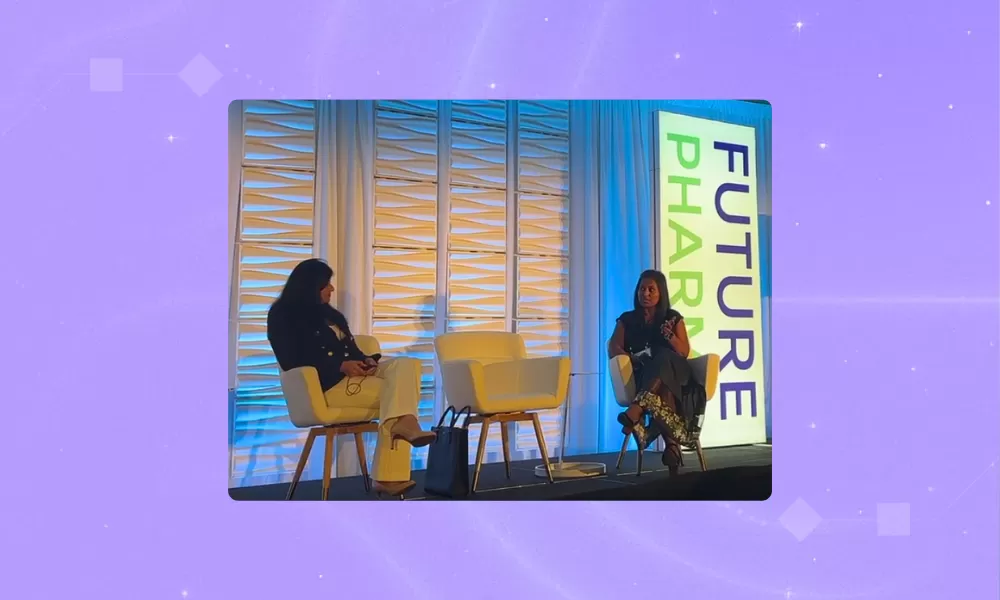
Discover the data-driven optichannel strategy and campaign framework that powered a remarkable rare oncology launch, as presented at Future Pharma 2025. It offers a strategic roadmap for launch success in the face of challenging market dynamics.
A fireside chat between Hemal Somaiya, Chief Strategy Officer at PharmaForceIQ, and Ramya Maddilate, Director of HCP & KOL Marketing at Day One Biopharmaceuticals, highlighted the power of a data-driven optichannel marketing model to drive measurable outcomes. Their discussion illuminated how this approach enables success by connecting with healthcare professionals (HCPs) at precise moments of opportunity with highly personalized content to ensure patients and their families can access this new therapy.
Beyond omnichannel: Defining optichannel
The conversation started by contrasting omnichannel and optichannel engagement.
While omnichannel gained buzz with its emphasis on connecting all customer touchpoints, the future lies in moving beyond mere connection. Hemal Somaiya noted that technology enables deeper engagement by “leveraging real world data at the individual HCP level to truly reach every customer in a hyper-targeted, personalized manner and reach them in that moment of opportunity when it matters the most.”
This is the essence of optichannel: optimizing channel and tactic selection and content deployment based on live real-world data, individual behavioral and preference data, and impacts on business outcomes.
"It's not just connecting the dots, it's leveraging the right data set to connect these dots and inform personalized, hyper-targeting at the individual level," Somaiya stated, to improve customer experience, focus resources, and maximize impact.
Launching a rare disease with complex challenges
Ramya Maddilate from Day One Biopharmaceuticals shared a compelling look into how their small biotech navigated the launch of a new therapy using an optichannel approach. Their challenges were multifaceted, as Pediatric Low Grade Glioma (PLGG) is a rare and unique tumor type that isn’t managed like a typical oncology indication.
Identifying patients was difficult due to the lack of a single ICD code, requiring reliance on multiple real-world datasets to identify these patients. The patient population is small, and the providers who treat PLGG are highly specialized. Furthermore, while a form of cancer, PLGG is managed more like a chronic condition with a highly variable treatment window so ongoing relationship building is essential.
Day One’s agile and digital-first philosophy, empowered by optichannel, became a critical advantage in bringing their first drug to market successfully.
The power of accurate and deep HCP affinity data
A cornerstone of optichannel isn’t just data–it’s actionable, highly accurate real-world customer affinity data. As Hemal Somaiya noted, “You can have the best machine learning platform, and you can have all your channels connected to each other, but if the data feeding this platform is garbage in, then you are going to get garbage out.”
This underscores a crucial investment for marketers: prioritize data quality and depth. Without it, even sophisticated platforms will fall short in delivering truly personalized engagement.
Ramya Maddilate contrasted Day One’s experience with traditional media planning: “What we used to normally do as brands is list match and look at very high-level channel-specific engagement data for your target list.” However, PharmaForceIQ’s deep affinity data provided “real-time, first-party data that is available at our fingertips, which allows us to make really informed and smart decisions on which channels to use.”
Granular data unlocks strategic agility, empowering marketers to allocate resources to channels and platforms where individual HCPs are most receptive.
“This depth of data really allows us to make our media plan very dynamic, and our engagement rates at an individual physician level are high as well. So with every single channel and every single media dollar that we are spending, our dollars are working smarter, not harder for us,” said Maddilate.
Trigger-based targeting to reach HCPs at the right moments
Rather than less effective “spray-and-pray” approaches, uniting affinity data with trigger-based media deployment was critical for Day One. Maddilate emphasized the paradigm shift to proactive and rapid targeting: “It’s all about identifying that right patient with the right physician and engaging with them at the right moment.”
Initially, they relied on real-world claims data to identify key moments for physicians treating PLGG patients. To supplement this, Maddilate shared how they augmented this data with behavioral-driven triggers, sharing examples such as “any physicians who engaged with our disease education, attended our peer-to-peer programs, or searched online looking for information about our competitive products.”
This allowed them to define a broader base of relevant providers and deliver valuable education over time due to the chronic nature of the disease, in addition to dynamically deploying content precisely and rapidly when it resonates most with an HCP’s current clinical and informational needs.
Content orchestration for deeper engagement
Beyond precise targeting, content strategy was also critical. Day One took a holistic approach with both promotional messages and KOL-driven content to ensure a balanced, credible, and comprehensive flow of information. Maddilate highlighted the importance of “orchestrating a truly personalized cross-channel journey for our physicians” that builds confidence, creates real value for HCPs, fosters enduring relationships, and drives adoption.
As Hemal Somaiya noted, the optichannel approach allows marketers “to truly understand in a real-time manner what this individual HCP is engaging with, then navigate a content journey that is personalized and meaningful in taking them from awareness to education deeper into adoption.”
"This was key across multiple segments key to patient care in this indication. Technology empowered Maddilate and her team to easily “tailor these individual journeys for thousands of healthcare providers–not just physicians, but also nurse practitioners and every single touch point within the care team."
Campaign success and future trajectory
The results of this optichannel campaign were compelling: 60% of unique new prescribers were directly attributable to the campaign within 12 months post-approval.
As Maddilate shared, on average these physicians engaged “6 or more times with the branded content or third-party thought leader content before they wrote that prescription.” This underscores the power of sustained, personalized engagement in driving behavior change.
Importantly, a significant proportion of prescribers were only engaged via the optichannel campaign with no field engagement. For a small company with a lean sales team, this was transformative. Optichannel augmented the sales team’s efforts at high-volume accounts and also extended reach into other healthcare systems where relevant patients were receiving care.
As Somaiya emphasized, a true differentiator of optichannel lies in its ability to shift focus from leading indicators or vanity metrics to meaningful ROI metrics: “You’re truly meaningfully tracking everything to the ROI metrics that matter most. It’s the prescription lift, it’s the revenue lift, it’s the journey flow that’s truly moving the needle for the brand.”
Looking ahead, Day One is layering in predictive analytics to continue narrowing in on the right moments for education, as machine learning helps predict when a physician might consider a treatment switch to a second-line therapy. This will help their data-driven team continue to grow the brand, educate stakeholders effectively, and ensure that PLGG patients, their families, and their HCPs can have informed and meaningful conversations around important treatment decisions.