
Summary:
As 81% of healthcare providers consult AI tools, life science leaders must pivot from measuring surface-level Share of Voice to capturing high-intent Share of Answer (SOA). Based on insights from three industry experts, this operational guide outlines how to adapt to a zero-click environment by reorganizing brand messaging around top HCP clinical queries, unifying Medical Affairs and Brand terminology into structured MLR-cleared data sets, and deploying content across an expanded optichannel footprint. Learn how to audit your brand’s presence across clinical and general AI engines using three core metrics: Inclusion, Accuracy, and Sentiment.
Healthcare professional (HCPs) usage of AI tools has skyrocketed from 38% to 81% in just two years, according to the AMA. Leading clinical engine OpenEvidence alone reports that practicing physicians ask about 1.5 million queries every day, totaling 35 million each month. As answer engines synthesize clinical data and provide instant, zero-click answers, the traditional push model (reliant on impressions, reach, and site traffic) is becoming obsolete. If your brand isn’t cited when an HCP asks a clinical question, you are effectively filtered out of the treatment decision.
In a recent webinar hosted by PharmaForceIQ and Fierce Pharma, leaders from Novartis, Bristol Myers Squibb, and PharmaForceIQ discussed how pharma marketers must pivot from measuring Share of Voice to winning Share of Answer.
What to expect:
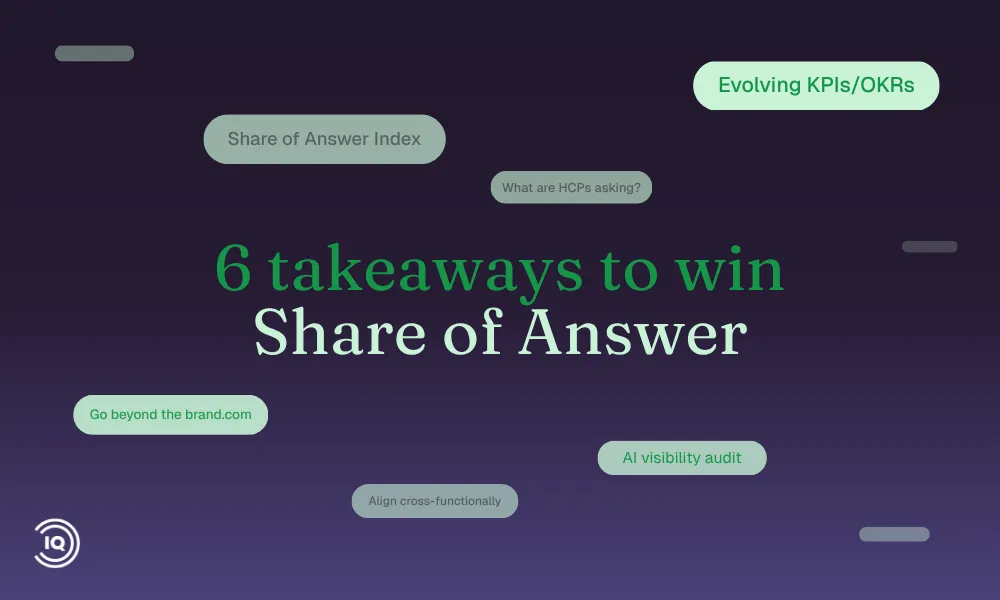
– Takeaway 1: Traditional web traffic is dropping, so KPIs or OKRs must evolve.
– Takeaway 2: Measure what matters with a Share of Answer Index.
– Takeaway 3: Reorganize content around HCP clinical questions.
– Takeaway 4: Expand your optichannel footprint beyond Brand.com.
– Takeaway 5: Elevate Medical Affairs as a critical force multiplier.
– Takeaway 6: Run an AI visibility audit today to build your new roadmap.
1. Evolve Beyond Reach Metrics as Brand.com Traffic Declines
Brand website traffic is declining because of stricter privacy/cookie restrictions and physicians getting zero-click answers inside AI tools. Continuing to judge campaign success on clicks and open rates paints an incomplete picture. Marketers must pivot toward business outcome metrics and OKRs defined before launching campaigns.
“Move away from measuring activity toward measuring business outcomes… Rather than asking ‘Did someone click?’ we are starting to ask ‘Did we reduce friction? Did we accelerate the customer journey? Did we ultimately influence business performance?” — Dana E. Cohen, Marketing Director, Bristol Myers Squibb
Action item: Stop evaluating digital campaigns on surface-level vanity metrics, or waiting until after campaigns launch to identify goals and metrics. Frame your 2027 brand plans around KPIs (or OKRs, if that’s what your company uses) that measure journey acceleration, customer friction reduction, and impact on growth.
2. Measure Commercial Performance via a Share of Answer Index
To operationalize Answer Engine Optimization (AEO), commercial teams must systematically track how answer engines treat their brand. Instead of guessing visibility, deploy a weekly Share of Answer Index that evaluates key HCP questions across three specific core dimensions:
- Inclusion: Is the brand cited in the AI-generated clinical response?
- Accuracy: Does the AI output match your approved MLR clinical evidence and claims?
- Preference/Sentiment: How is the brand ranked and framed relative to competitors?
“When a physician asks a question, the question that matters now is: Are we in the answer? Maintaining that discipline around questions, scoring those questions across all relevant answer engines, and taking action is the new approach.” — Derek Choy, Head of Product, PharmaForceIQ
Action item: Catalog the top 100 high-intent clinical questions in your therapeutic category and baseline your brand’s Inclusion, Accuracy, and Sentiment scores.
3. Reorganize Brand Content Around HCP Clinical Questions
Doctors don’t search for keywords, and they never did. They search for clinical questions within decision-journey frameworks. Traditional website structures (Efficacy, Safety, Dosing) create friction for machines indexing information and don’t mirror customer behavior. Commercial teams must reframe brand copy directly around the specific questions physicians ask.
Furthermore, AI engines punish inconsistency. If field reps describe a clinical scenario using one set of terminology (“purple horse”) while patients or brand portals use another (“lavender pony”), AI tools fail to index the connection.
“AI rewards companies that are specific and consistent in their messaging… audit the content you have. At most organizations, we don’t have a content problem; we have a discoverability problem and a consistency problem.” — Dana E. Cohen, Marketing Director, Bristol Myers Squibb
Action item: Solve for the “purple pony, lavender horse” disconnect when even internal teams use slightly different language. Align vocabulary across sales, marketing, and medical, then build a structured, machine-readable Q&A evidence package that reflects this shared terminology (approved by MLR) and that propagates centrally across brand websites, peer-reviewed citations, ad creative, and AI context engines.
4. Expand Your Optichannel Footprint Beyond Brand.com
Managing digital properties in isolation is a recipe for invisibility. AI engines rarely rely on brand sites alone, and marketers must navigate two distinct algorithm types with opposite citation rules.
General engines (like ChatGPT or Perplexity) pull heavily from open community channels like Reddit, LinkedIn, YouTube, and PR distributions. These sources represent roughly 38% of citations, while brand websites capture just 9%.
Endemic engines like OpenEvidence rely deeply on clinical authorities like JAMA or The New England Journal of Medicine. Peer-reviewed clinical authority sources jump to 78% of citations, while open community sources drop to 3%.
“When people think about influencing answers, they often think about AEO on our websites… We really have to think beyond that because the sources that answer engines leverage when coming up with answers are way [beyond] websites.” — Derek Choy, Head of Product, PharmaForceIQ
Action item: Use thoughtful planning for always-on and individual HCP channel affinity data for hyper-targeted placements to push verified, structured content into the specific third-party publishers, clinical channels, and digital spaces your target prescribers actually trust and frequent–and that AI engines use as critical sources.
5. Elevate Medical Affairs as a Commercial Force Multiplier
AI engines don’t care whether evidence comes from Marketing or Medical Affairs, and customers don’t really differentiate between them. Because clinical answer engines rely heavily on Retrieval-Augmented Generation (RAG) to scan medical journals and unbranded scientific data, Medical Affairs holds a key part of the AI discovery process.
“Activities that occur on the Medical Affairs side contribute directly to how we do in AEO… These combined efforts act as force multipliers for performance.” — Brian Bieniowski, Director, Web Strategy, Novartis
Action item: Break down internal silos to deepen impact. Partner directly with Medical Affairs to ensure deeply technical, unbranded scientific evidence is structured, crawlable, and aligned with core brand positioning.
6. Audit Your AI Visibility Today to Drive Impact in 2027
Adapting to the AI era does not require tearing down your existing MarTech stack. It is an evolution built on foundational web crawlability, quick-win content optimizations, and intentional data infrastructure.
“The most important thing is just to get started. We had a lot of brands who were intimidated by the amount of change and thought we would have to blow up everything, which just isn’t the case… Focus on low-hanging fruit.” — Brian Bieniowski, Director, Web Strategy, Novartis
Action item: Do not wait for market maturity, and don’t be concerned that you need to scrap everything you’ve already achieved. Start with running an immediate AI visibility audit across general and clinical answer engines to identify immediate gaps in your brand’s citation footprint. Then tackle longer-term needs like cross-functional alignment and MLR approval for shared content.
Take the Next Step
Winning in the AI era requires replacing generic reach with hyper-targeted, answer-driven engagement.
Watch the on-demand webinar here to listen in on the complete discussion with Novartis, BMS, and PharmaForceIQ.
Ready to build and execute a strategy that drives real Share of Answer?
Build your Share of Answer strategy
"*" indicates required fields