
When healthcare providers jump between ten or more digital sources for information, starting an effective digital education program feels like a Herculean task for many Medical Affairs teams. The goal is reaching the right providers with scientific integrity in the right channels to support decision-making, not just adding to the noise. Achieving that goal can be deeply challenging.
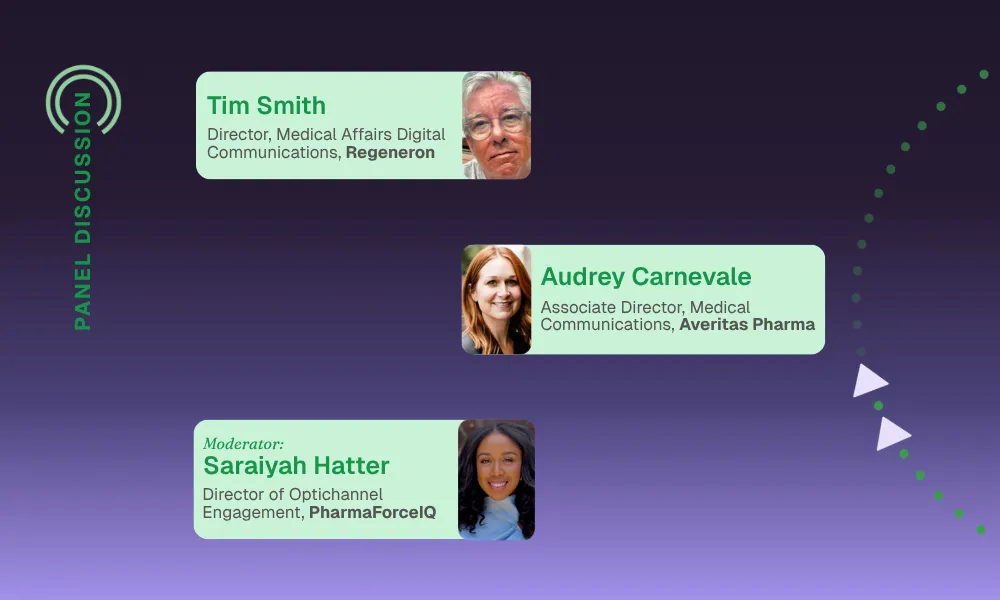
At the 10th Digital Strategy and Innovation for Medical Affairs conference, Saraiyah Hatter (Director of Optichannel Engagement at PharmaForceIQ) sat down with Audrey Carnevale (Associate Director, Medical Communications at Averitas Pharma) and Tim Smith (Director, Medical Affairs Digital Communications at Regeneron) to chat about compliant, efficient, and measurable digital engagement campaigns that follow a targeted optichannel approach. Here are the highlights from that discussion.
Defining the shift: From everywhere to optimal
Saraiyah Hatter started by defining key terms that cause confusion:
- Multichannel: Using different channels that are disconnected
- Omnichannel: Being everywhere at once to deliver consistent experiences
- Optichannel: Use predictive intelligence to focus only on the places HCPs actually spend their time
This resource-conscious approach helps teams balance engagement plan breadth and depth with investment only on the most effective channels for their audience. That makes optichannel a natural strategy for resource-constrained Medical teams.
Audrey Carnevale, a PhD scientist by training, noted how it’s common for Medical teams to feel overwhelmed in digital. Aligning on the audience, what data you have, how that fills an educational gap, and upcoming data is the best place to start. “We’d love to do it all, but that doesn’t make sense strategically or from a budget perspective,” she said. “Defining what good looks like in the next three to six months, versus the next year to 18 months, is where we expand our digital portfolio.”
Compliance and legal as partners, not barriers
Many leaders hesitate to even try because they assume Legal, Regulatory, and Compliance will block digital orchestration. Both Tim Smith and Carnevale noted that success comes from treating these teams as partners, not obstacles. As Smith explained, their role is both to protect and to collaborate on solutions. “If you approach it more on a partnership basis – ‘This is what we’re thinking, what do you think? Where do you think we could go with this? Where can’t we go with this?’ – they’ve been very honest and upfront.”
Examples or case studies of other Medical campaigns are valuable. They “are most comfortable when they know we’re not the first to do it,” Carnevale explained. “Showing that it’s been done before in this space has been really helpful to set that precedent and start the conversation with not, can we do this, but how can we do this responsibly.”
Her team does a risk assessment early on plan impacts, mitigation, and what may be lost if they don’t move forward. She also established an executive-approved, repeatable framework for digital content documentation. “When downstream reviewers are looking at the content, we have a referenceable document that has been approved from the executive level, showing this is what we’re comfortable with moving forward and how we’re going to execute.”
Smith also discussed the importance of internal education, both for legal/regulatory teams and more broadly across Medical. “You have as much of a job to educate them as anything else,” he said. “These aren’t marketing people. They’re scientists, they’re physicians, they’re pharmacologists.”
The inherent value of scientific credibility
Hatter notes that after aligning on fundamentals, you can then layer on audience affinity intelligence to understand where to deliver content to those HCPs. And once a campaign launches, Medical Affairs has a natural advantage over commercial teams that supports engagement: Trust and scientific depth.
Carnevale pointed out that while other teams might have larger budgets, they often lack the scientific depth required for true education. “It’s much more credible coming from the medical affairs side,” she said, noting that this is exactly what helps physicians make better clinical decisions.
For educational impacts, click-through rates rarely tell the full story. Leaders should look for tangible success markers, such as changes in online behavior, increased depth of knowledge in KOLs, and more HCPs being engaged.
Smith described using deep pre-campaign research on the audience and dynamic affinity intelligence to understand where to engage to drive traffic to a dedicated medical portal. By then measuring engagement through web analytics and other methods, teams can assess if the science was being absorbed.
Hatter added that repeat engagement offers another clear signal. “In some of the campaigns we’ve run for Medical Affairs at PharmaForceIQ, we’ve seen HCPs come back to engage and click on banners 20 or 30 times, knowing that it’s going to drive them to that education portal. That repeat engagement is also a strong sign of impact.”
A force multiplier, not a replacement for the field
A common concern is that digital tools might replace Medical Science Liaisons (MSLs). The panelists argued that it’s in fact the opposite. Digital can “soften the ground” for face-to-face interactions because it empowers HCPs with baseline knowledge before that personal conversation.
Smith agreed, noting that MSLs who were initially skeptics have become champions as they see how digital education makes HCPs more prepared for their visits. His field team now knows that digital can “help educate so that the door is part-way open when you start the conversation.”
Carnevale, a former MSL, noted that digital touchpoints also keep the conversation going between visits. “What if you’re able to walk back in and meet with that KOL again… and take the conversation deeper because they’ve had multiple touchpoints since your conversation?”
Planning for the future and getting started
As teams plan for the coming year, the panel offered a few concrete starting points.
- Don’t try to target every provider, as that will use your budget inefficiently. Target those with a specific educational gap, identified using quantitative data.
- Don’t feel locked into the traditional 12-month campaign model that brand teams traditionally run. Effective educational campaigns don’t need to run all year, as Hatter noted, and 4-6-month campaigns centered around a major congress or conference can drive clear impact.
- Personalization is easier than you may think. As Carnevale pointed out, “Segmenting in a lot of different cuts can help you take the same content and personalize it by just tweaking a few words… Try one or two small changes, and then ensure you can track and measure the engagement metrics from those small changes.”
By focusing on precision over mere presence, the move to optichannel ensures the voice of science remains prominent and cements Medical Affairs as a strategic driver of HCP education.