
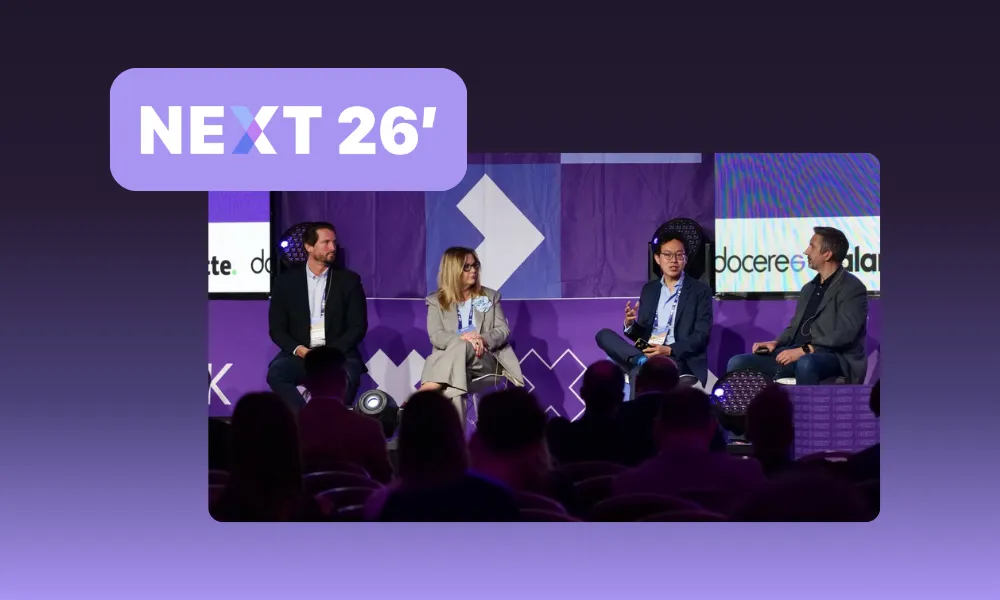
How are AI engines like ChatGPT and Claude transforming the way healthcare professionals (HCPs) find medical data and information? In this “Commercial Reloaded” panel discussion from NEXT Pharma Summit in Dubrovnik, industry experts dive into the radical shifts happening in healthcare communication and why traditional engagement models are no longer enough.
Panelists:
- Paul Tunnah (Moderator) – CEO of VuuAI
- Barbara Albientz – Former Head of Business Innovation, Helvion Therapeutics
- David Vanni – Customer Strategy at Novartis
- Derek Choy – Head of Product at PharmaForceIQ
It's I hope it's gonna be, worth the wait. Our next panel, is called commercial reloaded. Are we ready for today's and tomorrow's HCPs? So please welcome on the stage former head of business innovation, miss Barbara Albientz, David Vanni from Novartis, Azeeza Sunmono from Mundipharma, and Derek Choy from PharmaForceIQ. Hey everybody. For those that don't know me, I'm Paul Tunner, CEO of View AI, a content AI startup. I love Steph's presentation. Completely agree with everything he said. This is about reimagining the way we work, not just about making things quicker. And that's what we're gonna talk about on this panel. Because if you're gonna reimagine the way you work, you want to do that around the evolving customer needs. Because I've worked in this industry for twenty five years. I know I don't look that old. You're very kind. But I've worked in this industry for twenty five years and I've seen HCP and patient needs change so dramatically. And we have to be responsive and reactive to that. So we're going to talk about that and to set the scene I'm going to hand over to Derek first of all to show us some data exactly about HCP needs are evolving and we're then going to chat through what that means. Derek over to you. Thanks Paul. Hi everyone, I'm Derek. So I, in the last twelve years I've been pioneering field next best action as part of Aktana. And Aktana got acquired by PharmaForce IQ earlier this year. And so I've been expanding my focus to thinking about how HCP preferences have been changing. And so we do wanna share today a couple of stats on how, like I think that really highlight how that's evolved. But I would say that just because of my lessons through what I've done, it's really all about the individual behind the stats. So as we start thinking about how HCPs are changing, we're gonna dive into that. So first stat I think that we're probably all pretty familiar with is the stat from ChatGPT earlier this year which is three twenty million health queries occur on ChatGPT every single week. But behind that, what's happening with the physicians where patients are visiting them? Half my patients come in quoting AI now, so I'm using it too just to keep up. And I think that what that means as we hear is that physicians are now using AI, seventy five percent of European physicians are using it for medical reasons, and four and five are looking there for answers before they actually talk to a rep or an MSL. And I think fifty four percent even prefer it. When a tricky trial question hits at midnight, I don't text my MSL anymore. I ask AI. Honestly, that's my first stop now. And I think it's not just about actually how physicians are engaging. It's actually also about who they actually are. I think something like this turnover, like one in five HCPs is new when you're looking across each HCPs at a hospital. Honestly I'm the third doctor in this role in five years. Reps keep building relationships with people who've already left. And when we look at who we even talk to and who we need to target, that's changing as as well. Twenty five percent of of of primary care visits now are managed by nurse practitioners in the US. I manage over two thousand primary care patients, but honestly, I've never had a single pharma rep visit. And I think the last thing we need to recognize is in the EU, people coming from everywhere. I think sixty percent of doctors are trained in another country. So with all that in play, think we all need to know and we remember that while we think about targeting segments, really it's not about the segment, it's about the individuals inside the segment. And so we are looking now at figuring out how can we optimize for each physician and their specific journey. And I think that maybe sets us up for what I think we need to talk about today. Yes, exactly, exactly. And before we dive in, maybe just a quick nod to Aziza who was supposed to be on this panel, sadly due to travel difficulties, couldn't be here. But I know in the prep call, she raised some really important points about cultural differences with doctors and thinking more about that aspect as well as everything else. So I just wanted to give a nod to that. It's a real shame she can't be here. So Derek, you've raised some important points there, some interesting data. And it just makes me think that ten years ago we were talking about Doctor. Google and the problems that Doctor. Google was talking. Now it's Doctor. Chat GPT causing problems for our HCPs. So things are really changing. So I'm going to ask David, let me start with you. Do a quick introduction to yourself and I'd love to hear your thoughts and reflections on how those needs are changing. Sure, thank you. It's a pleasure to be here. I work at Novartis in customer strategy. As a disclaimer, the views are my own here. And so how are customer needs changing? Beyond that, in a world where, and thanks to AI, information is commoditizing. And we're not, even as smart as we are, going to win against that. And no strategy will win against the internet. It's just too powerful. So as a customer strategy person, I ask myself how do I stay relevant in that change? Do I keep fighting a dying game or I pivot? And I think that we have to pivot and be more in the hospital, support more the clinical practice, reduce the frictions, because at the end of the day that's where science happens. It's doctors delivering drugs to patients. So that's the way I'm positioning myself today. Yeah, that makes sense. And Barbara same thing to you, I mean you gave a bit of an introduction, but how are you most seeing HCP needs change right now? Sure. So first of all, you for the question. But just about myself, I am actually working really at the crossroad of strategy and business innovation. So it's really bringing those both parts together. And what I'm seeing is that we are actually in a in a big gap. To me, are behaving exactly like we are behaving right now. We are looking for a very quick answer. And the very quick answer is actually it's either Google probably ten years ago, but nowadays it's ChatGPT, it is Claude, whatever it is. But that's how they get their access to the information, and that's actually, in my opinion, what we are competing against, if I may say. And I'm not sure we can win that competition by increasing share of voice or whatsoever. So I think we really have to change the way we look at it and really understand how we actually add value to physician. Because I think that's deep root deeply rooted what and how we need to change is how do we add value. And I am not sure by adding value we mean actually going for any better content or for actually a different channel, etcetera, etcetera. So it's really about how we can help them and really understand what their problems really are. Yes, yes, completely agree. That it's interesting you use that term share of voice because I used to hear that term used a lot and it was more in the context of competitive landscape. But it really is now share of voice. How do we compete with the AI engines? And again, I would just reference Steph's presentation. My worry for the industry is if we just keep doing what we're doing, but we do it quicker, cheaper, faster we're not gonna win. I think we need to change the way we do things. Totally aligned. So Derek I'm gonna come back to you. What does this mean in terms of engagement models? How radical do we need to be? Yeah I think it's a great question. And I love like when I think about shared voice, I mean shared voice has evolved for the digital era, clicks, impressions. But I think like, and you know it moved from like you know reaching frequency, but I think it needs to shift again and I think about it now is share of answer. Because ultimately if our brand message is not in the answer, then where does it exist? And so there's different ways you can optimize for that. Like we're starting to work with early adopters on thinking about a three pronged approach to try to get that share of answer optimized. And it's something, it's looking at of course your websites and how do you do AEO, answer engine optimization rather than SEO. I think it's also about then going in and understanding if you are targeting paid media ads, everyone is, you know all these new chat engines, some of them offer ads. So how do you make sure you offer that as well where physicians are going? And I think most important is how do you hyper target so you don't reach every, you don't just treat them all as one engine, but you think about for each ACP where are they going so you don't spend too much because it's a very expensive channel. Yep. And I think the last thing is just whether or not you're actually able to influence the answer itself by giving context to the answer engines. Yeah. I think that's actually if you ask me the key question right now, it's not necessarily about what content am I going to deliver to that specific HCP wherever it is the behavior is and segmentation is. It's really how do we actually make sure from a data stewardship perspective, how do we bring the right data in the right format to those AI's So basically, when physician are looking for the information, are getting the right information. And right now I'm not sure we are actually looking enough at the data stewardship angle and the format, if I may say angle, for AI to be able to absorb and to give the most relevant answer to the physician exactly at the moment they need it. So there's maybe I mean I would look at this, there's maybe three dimensions to this. One is take something like websites and you've mentioned GEO and AEO. How do we optimize those to make sure they're providing the right information, not just for people but for AI? The second dimension is what are the channels should we maybe be using that we're not using to tackle that? And the third dimension is things like field force, perhaps some of those non digital channels, what does it mean for them? I know these are really big questions, but David I'm interested to get your views to pick from what you've Where are we heading here? I think you said the keyword on which we usually test and validate AI are outcomes. The quality of the outcome, the usefulness of the outcome. What about our outcome, the messaging, with the content? Is it driving behavioral change? That's an outcome I want to see. Behavioral change at the hospital, in clinical practice. So going beyond simply delivering well a good message, but looking at the human impact. I think that's very important to go the next step. And yes, think that's something we have to do. And to what degree you talk about behavior change there. To what degree are we looking at that kind of direct behavior change? There's always been the model versus we're trying to maybe influence the AI bots and then that information is driving there. Are we running the risk of becoming one step removed there? So I think we influence through the content of course. And we're getting better at it. And AI is here to support. But also helping change behaviours in the practice of medicine. So some companies use field technical specialists, a bit like the OpenAI now and Anthropic are using forward deployed engineers, to make a bit of a parallel with AI companies. So some pharma companies are doing field technical specialists where they go in the hospital and they look at how to improve the operations of the hospital to the benefit of the physician, but not only, also the nurses, also very important stakeholders, to impact positively the patients. And that's removing the frictions I mentioned about. And that's how you can scale the usage of your product. So of course you have the prescription, that's almost day one, but scaling happens after the prescription. I would like to be a little bit controversial here. Mean, I love the behavioural changes, and I'm totally aligned with that. But I think what you described to me is also how do we learn to add value? Because I think we have been extremely good at delivering the message, to delivering it at the right time, to delivering it at right message to the right person, etcetera, etcetera. I'm not one hundred percent convinced we have been actually really good at adding value. And in order to add value, and that's what you described, is really to understand what helps actually, whether it's the physician, whether it's the nurse, but it helps the overall functioning of the specific ecosystem, I would Yes, yes, yes. So I think that's probably one of the areas and aspect we have to really change the way we are thinking and be more to be listening and to be understanding. And actually, we had a chitchat over coffee this morning is, I mean, this this we have this wealth of prompts that are going every day and every week into whatever AI system. Wouldn't it be worth to really understand what those prompts are about and really get those insights and really understand what the physician really want. Yeah. I mean you are you have some more expertise in that space. Right? Yeah. Absolutely. And I think maybe we're getting to this question about thinking about like how do we measure or how how do we know now in this new world Exactly. What's working? How do we measure? Yeah. And so as we're thinking about that, I think that measurement of this shared answer becomes very different than what we used to measure before. Absolutely. I think, you know, we start asking ourselves, you know, when someone's asking a question about therapeutic area or category, is our brand mentioned? Like, how accurate is that? Because often it's not very accurate depending on where which sources it was drawn from. And then also in the competitive mindset, how do we as a brand show up against the competitors favorably, unfavorably, accurately? So all those questions I think have to start being thought about and also we've got to measure it continuously because it just changes every week with the way that models work, with the way that citations are. So it's very changing this dynamic around this question. And you're right. There's almost like a whole new set of KPIs coming in as we think about the AI bots. But then I'd also say is there a risk that we lose the human connection in that process. So are we moving to a place where there's almost two sets of metrics as kind of how we're engaging with people, how we're engaging with the AI bots. Yes. So actually you're touching a good point here is I think the KPIs are really great to measure our performance and what we do and whether we do it great and so on and so forth. I think there is probably a set of metric that need to be also targeted to the machine learning, etcetera. But I also believe that there is another set of measurements, which is the customer performance indicators. Because in my opinion, this is almost going to generate or to create the link and to glue in between all those different metrics. Because right now we are measuring very well what we are doing. I think we have to improve on measuring what is happening in the entire new space. But I think we also need to understand and measure how basically we satisfy the customers, not how we are doing in terms of our sales force, our different aspects. Yes, completely agree. To that point, right? Doctors are changing. Patients are changing as well. And we have to work on that. Patients are better educated, or at least have more access to information. They come in front of the doctor with questions, sometimes even almost that they want to be part of the decision, which is good in a way. If it's HCP led of course. So this is new for the doctor. And we need to address that. And I think through patient activation on disease awareness campaigns, but also on the different technologies available for specific disease, you can help to channel those patients toward not just having information, but having the right information. That would be the key. Because otherwise you increase the burden towards the relationship between a patient and a doctor. And that's detrimental to the doctor. There's probably a whole separate panel there. Absolutely, it could be another panel. Patient impact or what patient needs are versus HTP needs and how we balance that responsibly. Given we've got a few minutes left and I know people are probably getting quite hungry, we'll not veer too far down there at the moment. But I do just want to come back to this kind of balance between human engagement and AI engagement. Obviously, I think AI has enormous potential, but I don't want to lose that human piece. So I want to spend the last few minutes talking about what is it that we keep doing from what we've been doing to maintain that? What should we maybe stop doing? Because I think I'm a big fan of as we do new things you can't just keep doing everything and add stuff in. What is maybe outdated at this point in time? Barbara, do you want to pick up on that? Or do you think everything we're doing is okay? We just keep reimagining? I think it's a good question. If you ask me just like that, what comes first to mind is really you're doing that push with that message, with that content that we want to deliver to the physician or to the nurse, right? I think what we have to really stop doing is to delivering what the message we want. I think we have to start delivering what they need. Yeah. Yeah, love that. I think that it takes me back actually to when we were I was first working on field next best action and the reps, you know, with the first deployment we did failed because we weren't taking into account what the rep needed and also what they wanted. And so we I came up with this, like, concept. But the way I think about it is feel right. Like, what feels right for the rep? What answers what they need at that moment? I think that's the same with, like, everything when it comes to adoption of AI and including physicians. Like, what question do they have? Whether or not they put it in an answer range or just they have it in their mind when they're having a conversation or searching what's their question and let's answer that. And I think that is really the human element of making it feel right for the David, anything you think we should stop doing? Stop doing I think what I'm looking at is really how do we protect trust in that new world with AI. What are the sources that are going become increasingly important, not just what you've heard or what you think you know, but where it comes from. And is that information usable? Can it translate, we're hearing translation before in other panels, into action, valuable action for doctors and patients. So really the full life cycle. And we not just have to have the credibility of the knowledge, of the medical knowledge, but we also need to make ourselves visible. And that's a complexity I think in our world where it's never been easier to say something or post something. How do you remain visible? Because being right and invisible is a real risk. Yes, completely agree. So the last minute or so and let's create hopefully a talking point that people can take into lunch. Something concrete they can take with them. I know it's a big topic. It's always much easier asking these questions than answering. But if there's one thing you'd say people should take away and say take a look at this, start to rethink this, what would that element be within customer engagement? I see you nodding. Do want to pick up on I mean I think for me I've said it already. I think how do you optimise the share of answer? Yes. Share of answer. Barbara? Yes. It's going to be about really looking into the governance, governance and making sure the data stewardship is there to be able to basically give that share of answer. For me it's to try to put yourself in the shoes of your customers. Doctors before being doctors are normal human beings, women and men. So try to understand what is their experience of leveraging AI tools, of engaging with those new channels of content. And then you will understand where you might have the chance to locate your own self in the future. Yes and I would just sort of close things by I think for me there's been quite a nice flow with the two sessions that came before ours and this one. It's almost like it's been planned actually. Where then as was talking about, rather like we are customer needs and evolving, really important. And then Steph was talking about reimagining the way we work, don't just make things quicker. And I feel like that's kind of where we've got to. And my plea for people here would be keep that customer centric view, their needs are changing, you have to focus on that. But don't assume you can deliver against that doing what you're doing. You do need to make time to reimagine. And with that reimagination, we can take it into lunch. I will thank our panelists. Thank you very much. Thank you so much. Thank you everyone. Thank you all one more time. And as you all already know, it's time for a break. The lunch is ready, and we'll gonna continue in an hour. So see you back at two PM sharp.
Paul Tunnah: Hey everybody. For those that don’t know me, I’m Paul Tunnah, CEO of VuuAI, a content AI startup.
This is about reimagining the way we work, not just about making things quicker. And that’s what we’re going to talk about on this panel because if you’re going to reimagine the way you work, you want to do that around the evolving customer needs.
I’ve worked in this industry for 25 years, and I’ve seen HCP and patient needs change so dramatically. We have to be responsive and reactive to that. To set the scene, I’m going to hand over to Derek first to show us some data on exactly how HCP needs are evolving. We’re then going to chat through what that means. Derek, over to you.
Derek Choy: Thanks, Paul. Hi everyone, I’m Derek. In the last 12 years, I’ve been pioneering field next best action as part of Aktana, which got acquired by PharmaForceIQ earlier this year. I’ve been expanding my focus to thinking about how HCP preferences have been changing.
We want to share a couple of stats today that really highlight how things have evolved. But I would say that, based on the lessons through what I’ve done, it’s really all about the individual behind the stats. As we start thinking about how HCPs are changing, we’re going to dive into that.
The first stat that we’re probably all pretty familiar with is from ChatGPT earlier this year: 320 million health queries occur on ChatGPT every single week. Behind that, when looking at what’s happening with physicians where patients visit them, they are saying, “I have my patients come in quoting AI now. So I’m using it too just to keep up.”
What that means is that physicians are now using AI. 75% of European physicians are using it for medical reasons, and four in five are looking there for answers before they actually talk to a rep or an MSL. Furthermore, 54% even prefer it. When a tricky trial question hits at midnight, doctors are saying, “I don’t text my MSL anymore. I ask AI. Honestly, that’s my first stop now.”
It’s not just about how physicians are engaging; it’s also about who they actually are.
When you look across HCPs at a hospital, the turnover is roughly one in five. We hear things like, “Honestly, I’m the third doctor in this role in five years. Reps keep building relationships with people who’ve already left.”
When we look at who we need to target, that’s changing as well. 25% of primary care visits in the US are now managed by nurse practitioners, who manage over 2,000 primary care patients. Yet, they note, “Honestly, I’ve never had a single pharma rep visit.”
Lastly, we need to recognize that in the EU, people are coming from everywhere—60% of doctors are trained in another country.
With all that in play, while we think about targeting segments, really it’s not about the segment; it’s about the individuals inside the segment. We are looking now at figuring out how we can optimize for each physician and their specific journey.
I think that sets us up for what we need to talk about today.
Paul Tunnah: Yeah, exactly. Before we dive in, maybe just a quick nod to Aziza, who was supposed to be on this panel but sadly couldn’t be here due to travel difficulties. I know in the prep call, she raised some really important points about cultural differences with doctors and thinking more about that aspect as well. It’s a real shame that she can’t be here.
Derek, you’ve raised some important points and interesting data. It makes me think that 10 years ago we were talking about “Doctor Google” and the problems that caused. Now it’s “Doctor ChatGPT” causing problems for our HCPs, so things are really changing. David, let me start with you. Do a quick introduction of yourself, and I’d love to hear your thoughts and reflections on how those needs are changing.
David Vanni: Sure, thank you. It’s a pleasure to be here. I work at Novartis in customer strategy. As a disclaimer, the views are my own here.
How are customer needs changing? Beyond that, we live in a world where, thanks to AI, information is commoditizing. We are not going to win against that just by being smart. No strategy will win against the internet—it’s just too powerful. As a customer strategy person, I ask myself: how do I stay relevant in that change? Do I keep fighting a dying game, or do I pivot?
I think we have to pivot and be more present in the hospital, support clinical practice more, and reduce frictions. At the end of the day, that’s where science happens—it’s doctors delivering drugs to patients. That’s the way I’m positioning myself today.
Paul Tunnah: That makes sense. Barbara, same thing to you. If you could give a brief introduction, how are you most seeing HCP needs change right now?
Barbara Albientz: Sure. Thank you for the question. About myself, I work really at the crossroad of strategy and business innovation, bringing both of those parts together.
What I’m seeing is that we are in a big gap. To me, physicians are behaving exactly like we are behaving right now. We are looking for a very quick answer. Ten years ago that quick answer was probably Google, but nowadays it’s ChatGPT, Claude, or whatever it is. That’s how they get their access to information, and that’s actually what we are competing against. I’m not sure we can win that competition by simply increasing share of voice. We really have to change the way we look at it and understand how we actually add value to the physician.
Deeply rooted in how we need to change is asking: how do we add value? I am not sure that adding value simply means going for better content or using a different channel. It’s really about how we can help them and truly understand what their problems are.
Paul Tunnah: Yeah, completely agree. It’s interesting you use that term “share of voice.” I used to hear that term used a lot in the context of the competitive landscape, but now it’s about how we compete with the AI engines. Again, referencing Steph’s presentation, my worry for the industry is that if we just keep doing what we’re doing but do it quicker, cheaper, and faster, we’re not going to win. We need to change the way we do things.
Derek, coming back to you, what does this mean in terms of engagement models? How radical do we need to be?
Derek Choy: I think it’s a great question. Share of voice has evolved for the digital era with clicks and impressions, moving past just reach and frequency. But it needs to shift again.
I think about it now as “share of answer.” Ultimately, if our brand message is not in the answer, then where does it exist?
There are different ways you can optimize for that. We’re starting to work with early adopters on a three-pronged approach to optimize share of answer.
First, it’s looking at your websites and how you do AEO (Answer Engine Optimization) rather than just SEO. Second, it’s understanding paid media ads – some of these new chat engines offer ads, so you need to make sure you offer that where physicians are going. Third, and most importantly, how do you hyper-target so you don’t treat them all as one engine? You have to think about where each specific HCP is going so you don’t overspend, because it’s a very expensive channel. Lastly, it’s about whether or not you’re actually able to influence the answer itself by giving context to the answer engines.
Barbara Albientz: If you ask me, that’s the key question right now. It’s not necessarily about what specific content I am going to deliver to an HCP. It’s really about data stewardship.
How do we bring the right data in the right format to those AI platforms so that when a physician looks for information, they get the right answer? Right now, I’m not sure we are looking enough at the data stewardship and formatting angles required for AI to absorb and give the most relevant answer to the physician exactly when they need it.
Paul Tunnah: So there are maybe three dimensions to this. One is taking something like websites and using GEO (Generative Engine Optimization) and AEO to optimize them for AI, not just people. The second dimension is considering what other channels we should be using that we aren’t currently. The third dimension is the field force and non-digital channels—what does this mean for them? These are big questions, but David, I’m interested to get your views on where we are heading.
David Vanni: You mentioned the key word on which we usually test and validate AI outcomes: the quality and usefulness of the outcome. What about our outcome with messaging and content? Is it driving behavioral change? That’s the outcome I want to see—behavioral change at the hospital and in clinical practice. We need to go beyond simply delivering a good message and look at the human impact to take the next step.
Paul Tunnah: To what degree are we looking at that kind of direct behavioral change, which has always been the model, versus trying to influence the AI bots so that their information drives it? Are we running the risk of becoming one step removed?
David Vanni: We can influence through the content, of course, and we’re getting better at it with AI’s support. But AI is also here to help change behaviors in the practice of medicine. To draw a parallel with AI companies like OpenAI and Anthropic who use “forward deployed engineers,” some pharma companies are now using field technical specialists. They go into the hospital and look at how to improve operations to the benefit of the physician.
Nurses are also very important stakeholders to impact positively for the patient. This removes the frictions I mentioned earlier. That’s how you can scale the usage of your product. The prescription is almost step one, but scaling happens afterward.
Barbara Albientz: I would like to be a little bit controversial here. I love behavioral changes and I’m totally aligned with that, but what you described to me is also how we learn to add value. We have been extremely good at delivering the right message to the right person at the right time.
But I’m not 100% convinced we have been really good at adding value. To add value, as you described, you have to truly understand what helps the physician, the nurse, and the overall functioning of that specific ecosystem.
We have to change the way we are thinking to be more about listening and understanding. We had a chat over coffee this morning noting the wealth of prompts going every day and every week into these AI systems. Wouldn’t it be worth it to really understand what those prompts are about, get those insights, and understand what the physician really wants? Derek, you have some more expertise in that space, right?
Derek Choy: Absolutely. I think we’re getting to the question of how we measure what’s working in this new world. Measuring this Share of Answer becomes very different than what we used to measure before. We have to start asking: when someone asks a question about a therapeutic area or category, is our brand mentioned? How accurate is that? Often it’s not very accurate depending on which sources it was drawn from.
In a competitive mindset, how do we as a brand show up against competitors—favorably, unfavorably, accurately? We have to measure it continuously because it changes every week with the way models work and how citations shift.
Paul Tunnah: Right, there’s almost a whole new set of KPIs coming in as we think about AI bots. But is there a risk that we lose the human connection in that process? Are we moving to a place where there are two sets of metrics—how we engage with people versus how we engage with AI bots?
Barbara Albientz: You touch on a good point. KPIs are great to measure our performance and whether we are doing well. There definitely needs to be a set of metrics targeted to machine learning. But I also believe there is another set of measurements we need: Customer Performance Indicators.
In my opinion, this is going to generate the link and the glue between all those different metrics. Right now we are measuring very well what we are doing, and we need to improve on measuring what is happening in this new AI space. But we fundamentally need to measure how we satisfy the customers, not just how our sales force is performing.
David Vanni: I completely agree with that point. Doctors are changing, and patients are changing as well. Patients are better educated, or at least have more access to information. They come to the doctor with questions and want to be part of the decision-making, which is a good thing if it remains HCP-led. This is new for the doctor, and we need to address it.
Through patient activation, disease awareness campaigns, and educating on different technologies available, you can help channel patients toward having the right information.
Otherwise, you increase the burden on the relationship between the patient and the doctor, which is detrimental to the doctor.
Paul Tunnah: There is probably a whole separate panel there on patient impact and balancing patient needs versus HCP needs responsibly. But given we’ve got a few minutes left and people are probably getting hungry, I want to come back to this balance between human engagement and AI engagement.
AI has enormous potential, but I don’t want to lose that human piece. Let’s spend the last few minutes talking about what we should keep doing to maintain that, and what we should stop doing because it’s outdated. Barbara, do you want to pick up on that?
Barbara Albientz: What comes first to mind is the constant “push” of the message and content we want to deliver to the physician or nurse. What we have to stop doing is delivering the message we want. We have to start delivering what they need.
Derek Choy: Yeah, I love that. It takes me back to when I was first working on field next best action. The first deployments failed because we weren’t taking into account what the rep needed and wanted. I came up with this concept of “feel right”—what feels right for the rep and answers what they need at that moment?
I think it’s the same when it comes to the adoption of AI, including for physicians. What question do they have, whether they put it into an answer engine or just have it in their mind during a conversation? Let’s answer that question. That is the human element of making it feel right for the physician.
Paul Tunnah: David, anything you think we should stop doing?
David Vanni: I’m looking at how we protect trust in this new world with AI. Sources are going to become increasingly important—not just what you think you know, but where it comes from and if that information is usable. Can you translate that medical knowledge into valuable action for doctors and patients?
We don’t just need the credibility of medical knowledge. We also need to make ourselves visible. That’s the complexity in a world where it has never been easier to say or post something. Being right but remaining invisible is a real risk.
Paul Tunnah: Completely agree. For the last minute or so, let’s leave people with one concrete takeaway they can rethink within customer engagement as they head into lunch. Derek, what would that be?
Derek Choy: For me, it’s how do you optimize the Share of Answer.
Paul Tunnah: Share of answer. Barbara?
Barbara Albientz: It’s going to be about looking into internal governance and making sure data stewardship is there to be able to actually feed that share of answer.
David Vanni: For me, try to put yourself in the shoes of your customers. Doctors, before being doctors, are normal human beings. Try to understand their experience leveraging AI tools and engaging with these new channels, and then you will understand where you can position yourself in the future.
Paul Tunnah: I would just close by saying there has been a nice flow between the sessions today. We discussed how customer needs are evolving, and Steph talked about reimagining the way we work instead of just making things quicker.
My plea for people here would be to keep that customer-centric view. Their needs are changing and you have to focus on that, but don’t assume you can deliver against those needs by just doing what you’ve always done. You do need to make time to reimagine.
Thank you very much to our panelists, and thank you everyone.