
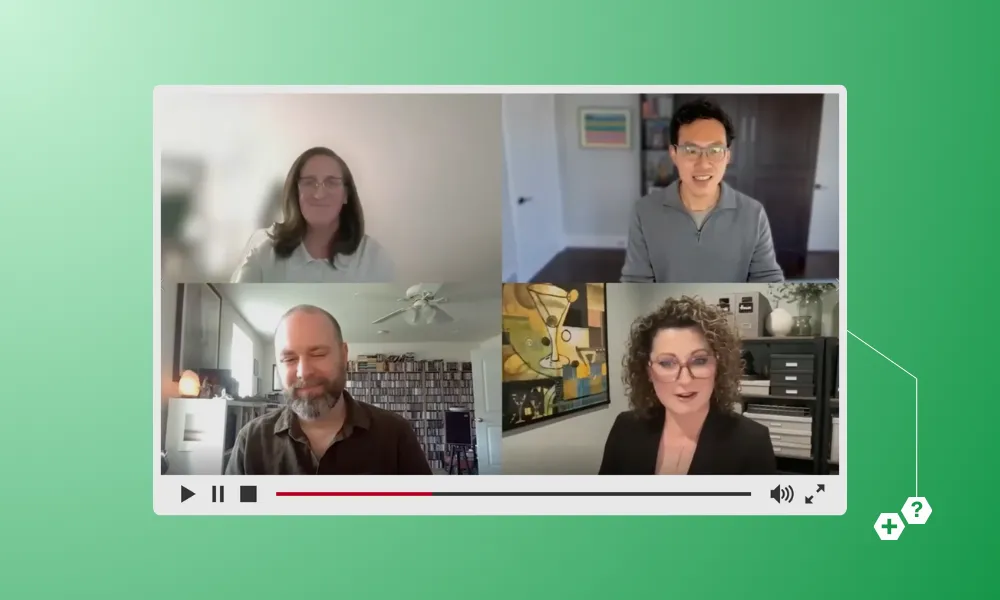
Summary: As HCPs increasingly rely on AI tools for clinical discovery, it’s time to pivot from traditional engagement metrics to a framework for Share of Answer in commercial pharma to ensure and measure brand inclusion in AI-generated responses. In this webinar, speakers from Novartis, Bristol Myers Squibb, and PharmaForceIQ discuss how to adapt, including reorienting content strategies around high-intent clinical questions, understanding these new HCP intent signals, and ensuring verified, machine-readable information is available across the channels where HCPs go for information and AI engines source cited content.
HCPs increasingly use AI tools to seek information, and those AI platforms often answer questions before a brand ever has the opportunity to engage directly. This is driving a generational shift in the industry from a push-based communication model to a new “pull” model driven by independent discovery and personalized answers, and traditional share of voice metrics no longer adequately measure impact in this model.
In this webinar presented by PharmaForceIQ and Fierce Pharma, leaders came together to discuss how commercial teams can rethink their approach to targeting, media, content, and customer engagement. Success will depend on improving visibility across emerging AI-powered channels while equipping field teams with deeper intelligence and real-time insights that enable more relevant, contextual, and personalized interactions with customers.
Key discussion points:
-
- Understanding the shift from Share of Voice to Share of Answer in commercial pharma and marketing initiatives
-
- Building optichannel engagement strategies for AI-driven customer journeys
-
- Increasing brand visibility across emerging AI-powered discovery channels
-
- Leveraging real-time insights and contextual intelligence to personalize engagement
-
- Enabling field teams to deliver more relevant, data-driven customer interactions
-
- Rethinking measurement and engagement metrics in the AI era
Speakers:
-
- Brian Bieniowski, Director, Web Strategy at Novartis
-
- Derek Choy, Head of Product at PharmaForceIQ
-
- Dana E. Cohen, Marketing Director at Bristol Myers Squibb

Before creating your 2027 plan, identify those top HCP and patient drivers. What does their journey really look like? Right now, AI is rewarding organizations that answer those real questions, rather than simply publishing more promotional content, because sometimes more is just more.
Dana Cohen
Marketing Director at Bristol Myers Squibb
Teams across the organization that typically haven't worked together before, such as Commercial and Medical Affairs, are seeing a cumulative effect. Activities that occur on the Medical Affairs side contribute directly to how we do in AEO, for example. We're seeing more locking of arms across teams that might not have collaborated before because these combined efforts act as force multipliers for performance.
Brian Bieniowski
Director, Web Strategy at Novartis
When the HCP asks the answer engine something, it reveals intent so much more clearly than what any passive impression or click ever told us. That question signal drives everything downstream. It can drive the content to create, the gaps of which questions you need to add to your verified source of truth... what follow up engagement you should have with a physician if you're hyper targeting them across multiple channels.
Derek Choy
Head of Product at PharmaForceIQ
Webinar recording:
Transcript for driving share of answer in commercial pharma webinar:
Lauren Leger: Good afternoon and thank you for attending today’s webinar, “Driving Share of Answer through Optichannel Engagement in the AI Era,” presented by PharmaForceIQ, Bristol Myers Squibb, Novartis, and Fierce Healthcare. I’m Lauren Leger, Conference Producer at Fierce, and I’ll be your moderator today.
It is now my pleasure to welcome our panelists: Derek Choy, Head of Product at PharmaForceIQ; Dana Cohen, Marketing Director at Bristol Myers Squibb; and Brian Bieniowski, Director of Web Strategy at Novartis Pharmaceuticals. To help set the stage, I’d love for each of you to briefly introduce yourselves and share a bit about your background. Derek, let’s start with you. Can you share a little bit about yourself?
Derek Choy: Sure, thank you so much, and I’m really excited to be here. I’ve been working in pharma for almost 15 years. I co-founded Aktana, where we pioneered next-best-action capabilities for the field. Following the acquisition of Aktana by PharmaForceIQ, I now lead product across both companies. We’re focused right now on hyper-targeted optichannel engagement for physicians across field and digital channels. As digital is evolving with HCPs use of answer engines, focus is shifting very much on how we help optimize for AI as part of that engagement. I’m excited to share my perspective today.
Lauren Leger: Great. Thank you, Derek. Dana, let’s come to you next.
Dana Cohen: Hi everybody. I’m Dana Cohen. I’m currently Marketing Director at Bristol Myers Squibb, where I lead brand and omnichannel for immunology. Over the past two decades—not to date myself, but I’ve been doing this a long time—I’ve had the opportunity to work across global, brand, and omnichannel leadership roles at companies including Teva, J&J, Nestlé Health Science, and BMS. Large or small, I’ve helped organizations navigate commercial transformation ranging from global strategies to brand-level omnichannel engagement and, more recently, our AI-enabled customers.
You know, today’s topic is close to my heart because part of my perspective is that marketing has continually evolved over the last 25 years, and AI represents the next step. I’m really excited to talk about that today with everyone.
Lauren Leger: Wonderful. Thanks, Dana. Brian, let’s round out introductions with you.
Brian Bieniowski: Thank you for having me, I’m excited to be here. My name is Brian Bieniowski, Director of Web Strategy for Novartis’s US commercial marketing organization within our martech practice. This is my 17th year in digital strategy. I am responsible for technology and platform strategy for the marketing technology stack, and I’m also responsible for emerging AI capability strategy in our US organization. It’s great to be here.
Lauren Leger: Thanks, Brian, and thank you all for those introductions. You each bring valuable perspectives to this conversation. So let’s dive in and explore how commercial teams are adapting to a world where share of voice is no longer enough and share of answer is becoming increasingly important. Derek, I’d love to have you kick us off here.
How should commercial teams rethink their strategy as we move from share of voice to share of answer, and what fundamentally changes as a result?
Derek Choy: For the last 20 years, we’ve all been measuring whether we reached customers to deliver our messages. Now when customers are starting with an answer from an AI engine before we reach out to them, things are just fundamentally different. I think 81% of HCPS now use AI professionally, and that’s up from 38% just two years ago.
While we used to have share of voice, which was a push model—impressions, reach, what we distribute across channels, and engagement—share of answer is a pull model. It’s when an HCP is asking the AI tool a clinically relevant question: Is your brand showing up? Is the evidence accurate, and how are you mentioned versus competitors? So that strategy now is understanding the questions HCPs are asking and then optimizing for the answer. I think that is a huge shift.
Lauren Leger: Great. Thanks, Derek. Dana, how are you thinking about this shift from a brand perspective?
Dana Cohen: So from a brand and omnichannel strategy perspective, I tend to take a step back because I think it’s helpful to first define the differences–because we often create new terminology before everyone really knows what it means. Years ago, you know, we talked about multichannel as we had a multitude of new digital channels become available to us. Then we shifted to omnichannel, which was connecting all those channels surrounding our customer. Today we’re talking about the share of answer, which has now obviously evolved once again.
To me, that real shift is not just push-to-pull marketing; it’s moving from brand-centric communication to being driven by customer discovery. Multichannel, omnichannel—it’s essentially just the next evolution in what we’re doing. It’s important to understand that because it’s not necessarily new, it’s just the next step, and now we simply need to continue that evolution.
Historically, we decided what messages we wanted to tell our customers: the right message at the right time. That was the core of what we did from a brand and omnichannel perspective. But this is why I tell brands all the time—and I can say this as a brand leader—it’s not about you, it’s about your customer. We’re in an age where we know more about people, what they do, and how they make decisions than we ever have. With AI driving that, it’s helping healthcare professionals and patients get to the answers to their questions faster. They’re doing a lot less digging; they want a quick answer.
Being able to speak to them in the language they want, not only in the channels they want, is the lens I look through, because marketing isn’t really about promoting a product. It’s about helping healthcare professionals and patients make better decisions based on the information in front of them. The organizations I have seen really embrace that—using AI to solve real problems HCPs and patients are having—are the ones who are succeeding. AI hasn’t really changed the mission, it’s simply changing how we fulfill it today.
Lauren Leger: Thank you, Dana. Brian, what stands out most from your perspective?
Brian Bieniowski: We’re treating this as a major generational shift for the organization and how we work. I would be lying if I said teams weren’t looking at it with some trepidation, fear, and maybe a little bit of panic. But I look at it—and I think the rest of our organization is evolving to look at it—as a really positive change.
It’s going to mean a lot of change in ways of working, especially around technology platform choices, how you manage, govern, and create content, and even how marketing teams operate. Internally at our organization, there’s a big evolution that will be required to meet this change.
But as Dana mentioned, it’s a good change because we’re starting to get better signals for what customers need from us. We’ll find that we can serve them better through our efforts because we’re getting much more direct information about what they’re looking for, what jobs they’re hoping to do, and what they need us for.
So our change is very much in progress. I’m proud to say we’re ahead of many competitors in terms of how far we’ve gone, but there’s still a lot to be done. There’s definitely organizational change coming around as a result, because it’s just such a big shift that we haven’t seen in many years.
Lauren Leger: Thank you for sharing those perspectives. We’ve started to unpack how the shift toward share of answer is changing the commercial landscape. So the next question is really how organizations determine whether those efforts are actually working. Dana, I’m going to start with you here.
How are you evolving commercial KPIs to better measure influence in this new environment? And what metrics beyond traditional reach are becoming most critical to your brand strategy?
Dana Cohen: This has been evolving for a while, and AI is pushing it even further. One of the biggest changes we’re making is moving away from measuring activity toward measuring more business outcomes. Traditional KPIs—clicks, impressions, reach—are still useful metrics and things we need today, but they don’t necessarily tell us whether we’re creating value in a particular area or campaign, or frankly, if it was successful.
So we’ve been evolving more toward an Objectives and Key Results (OKR) framework, which really starts with the business: What problem are we trying to solve? What’s the business objective? That’s what really matters, and what customer behavior matters to impact that.
For example, rather than asking, “Did someone click? Did they follow through and open this email?” we are starting to ask, “Did we reduce friction? Did we improve engagement quality? Did we accelerate the customer journey? Did we solve a problem for them? And did we ultimately influence business performance?” AI doesn’t change that core question, but it really does help us measure that better than ever before.
If anyone has ever been part of qualitative and quantitative research, we’ve all seen that people say they do one thing, but actually do another. AI helps us learn that what you say and what you do aren’t always one and the same. We dive into the psychology of how and why HCPs and patients make decisions—obviously with very different motives and approaching questions in different ways. It helps us better understand their key drivers and motives, which aren’t always what we think they are when we create our personas. If you’ve ever sat across from an HCP, you know they’ll sometimes tell you one thing and do something else—not intentionally, but just because of how people react day-to-day.
There’s a very interesting book called Predictably Irrational by Dan Ariely that talks about the psychology of why people make decisions and how and what we’re doing. It was ahead of its time, but I use it today when creating OKRs across our brands and organization because AI helps frame all the data we’re getting and puts it together in a way that tells a story. It’s quite fascinating. You can apply a lot of those principles today. When we glean data from our OKRs and apply that to creating a successful journey for either a patient or an HCP, we can essentially follow the yellow brick road and leave breadcrumbs for them. It’s a nice marriage of understanding the psychology, AI, and data today.
Lauren Leger: Thanks for sharing, Dana. Derek, how are you approaching this question around measurement and success?
Derek Choy: It’s a great question. I love what Dana was saying, because as an industry, we’ve always tried to understand our customers and take the physician perspective. But when you think about this new world where physicians are asking questions and share of answer determines how we respond, the question that matters now is: When a physician asks the question, are we in the answer?
It’s about measuring that. What we’ve seen to make this operational for customers is to use a Share of Answer Index, and we have multiple components that map to things teams can actually fix and do something about. For example, let’s say you’ve identified 100 HCP questions that matter to your category, then we measure:
- Inclusion: Are you in the answer, and how prominently?
- Accuracy: How accurate, because you want answer engines to match what your approved evidence and claims are
- Preference & Sentiment: When it comes to how you are mentioned or ranked versus competitors, how do you fit and what’s the sentiment?
What we’re starting to see is if you can measure this automatically and repeatedly—say, on a weekly basis—then you can see whether the actions you’re taking are working. You can also see, as things are changing in the technology and the answer engines in information that’s available to be cited, how you’re doing and adapting in real time. Maintaining that discipline around questions, scoring those questions across all relevant answer engines, and taking action is the new approach we’re seeing emerge.
Lauren Leger: Brian, what would you add to this?
Brian Bieniowski: Great points by everybody. I’ve only been in pharma for about six years. In prior industries I was involved in, we were always very customer-centered in how we made decisions and did work. So it was a surprise and it was a transition when I came into pharma to find that the business was not as customer-centered as it could be, or that certain practices hadn’t been built around that.
I’m actually excited because, with changes to share of answer alongside the evolving privacy landscape, website traffic is now lower because people are using answer engines rather than coming directly to our websites for information. Because of privacy regulations we also have less visible web traffic because of opt-in and cookie management policies.
What this means—and I think it’s positive in the long term, even though it’s changing how folks are going to have to work—is that you must become more customer-centered. You have to speak to customers to understand what they need because you won’t always be able to get the same signals that you used to get historically. Now we have a large amount of information coming from answer engines that we’ve had to get attuned to: How do we collect these insights and interpret what people are asking to optimize website content, and how do services on our sites need to evolve to meet customer needs? We may be seeing signals from HCPs or patients that we haven’t seen before, highlighting dimensions we can actually make a big impact on.
And I’ll make one more point: Teams across the organization that typically haven’t worked together before—such as Commercial and Medical Affairs—are seeing a cumulative effect. Activities that occur on the Medical Affairs side contribute directly to how we do in AEO, for example. We’re seeing more locking of arms across teams that might not have collaborated before because these combined efforts act as force multipliers for performance. It’s a lot of change for us internally, but I think all good.
Lauren Leger: Thanks, Brian. So we’ve covered how success is being measured in this new environment. The next question is what drives visibility and performance within AI-generated experiences.
Brian, what actually determines whether a brand shows up in AI-generated answers, and what are teams missing when it comes to influencing that visibility?
Brian Bieniowski: We’ve had to instantiate an organization-wide program to help improve this because there are many dimensions that could, large and small, that you can impact on your own. As an organization, it was really overwhelming for teams not knowing where to start or what would be most impactful. It’s a new world, so we don’t always know. We’re making informed bets rather than being able to offer certainty to teams to say if you do this activity you will see an 8% uplift. We don’t have that kind of certainty—and I would add that I don’t think we ever had it.
What we’ve done is roll out an organization-wide awareness campaign that we’re doing internally just to let people know why this is important, what it is. Then we created—we jokingly call it our “Jeopardy board”—a large list of particular tactics that we recommend doing to help improve our performance externally.
For us, there were platform enhancements that we needed to do to make sure that information was more crawlable. We were in pretty good shape with that, but we still had things that were emergent that we needed to do just to get platform technology in a place where we would be more crawlable by bots.
And by far the biggest improvements that were required in an organization were around content creation and how content is used. And so we talked about new signals coming in around what questions HCPS, for example, are asking. We really, really needed to be focused on that to be able to better optimize our content to then meet those needs.
So I think what we’re seeing is there is going to be a really great, better feedback loop to say, let’s look at what’s happening out in the marketplace, what people are searching for, what they need, pay attention to those things and then adjust what our tactics are and then measure in a cycle–as we would in any digital activities to see what the impact of those things are.
It’s not something that we’re going to do overnight. It’s definitely, for us, a multi-month, multi-year initiative. But I really think overall it’s going to make us all better marketers and be more beneficial to the HCPs who come to us for information and support.
Lauren Leger: Thanks, Brian. Dana, I’d be interested in your perspective on this as well.
Dana Cohen: Brian, I think that you make a lot of good points and it’s, it’s very true. For years, we’ve spent time optimizing for keywords. Now we’re just shifting it to optimizing for questions. Healthcare professionals don’t think in keywords. Many of us who have worked in both HCP marketing and patient marketing have seen that carry over even in certain things like SEO and search.
You’ll constantly hear me banging the drum for content because I fully believe content is king; we just need to shift how we look at it. Again, I go from keywords now optimizing for questions, HCPS just think in clinical questions. How we frame content is central to our strategy and our content strategy.
It’s a very good example of something I’m living and breathing today with one of my brands: instead of organizing a website the way we typically do with Efficacy, Safety, Dosing, and Resources, why wouldn’t we–a little change management is required–but why wouldn’t we shift and organize content around the customer journey and the way HCPs make decisions? It creates a little less of a buffer. I go back to the yellow brick road. I want them to create a journey and be able to follow it naturally, not necessarily the way we as a company believe that they should, but the way they really do in reality. Sometimes those things are not one and the same.
That’s a really big piece of where I focus and spend a lot of time with the brands that I work on today in changing and kind of breaking that old habit. I go back to saying it’s not about us, it’s about how they want to digest information. And those are the brands that will win in the future. The ones that can break through that and be the ones where the AIs can look at the content and say this is the most trustworthy answer to the questions that the healthcare providers are asking. And that’s going to be what really, in turn, ends up making better content.
Lauren Leger: Thanks, Dana. Derek, what are you seeing in this area?
I’ll add a little bit more practically about what we tend to see and we’re doing for our customers: when people think about influencing answers, they often think about Answer Engine Optimization (AEO) on our websites. The key thing that we’re seeing is we really have to think beyond that because the sources that answer engines actually leverage when they’re citing and they’re coming up with their answers is actually way more than the websites.
General answer engines pull from the open web, favoring community sources like Reddit, LinkedIn, YouTube, and PR distributions, much more than a brand websites. Endemic engines like OpenEvidence leverage clinical authority through partnerships with JAMA and The New England Journal of Medicine.
What this means is we need an HCP-centric approach focused on questions and content optimization across multiple prongs and multiple services:
- We do need the AEO optimization, the structured citation ready machine readable content.
- I really believe in what Dana was saying: we need to think about those HCP-level questions: what are our customers asking, and then use that to generate a verified source of truth with approved answers. As Brian was saying, across commercial, medical, legal and structured in a way so that machines can use them.
- Then we’re going to get that content out to many sources beyond the website.
- The other thing I would say is there are other opportunities to influence share of answer. We see the value in using paid presence in the AI channels that actually allow it, and you can use surround sound for some of the questions and the answers.
Then we’re even finding ways to help customers get the approved evidence directly into the context of the answer engine itself. It’s an exciting area that is evolving super quickly as AI advances.
Lauren Leger: Great, thanks for sharing. We’ve discussed how brands can improve visibility within AI-generated experiences. The next challenge is turning those insights into coordinated customer engagement across channels. Dana, I’ll turn this one over to you first.
So when we talk about optichannel engagement, what are the foundational capabilities that organizations need to orchestrate across AI, digital, and field interactions?
Dana Cohen: We all love the field—they’re our biggest channel, yet sometimes our biggest struggle. The field is one channel in omnichannel, and every channel is just another lever we have the ability to pull. Precision sales has a major place, and its role is distinct from AI infrastructure.
Optichannel is about translating decision-making into share of answer. When building foundational capabilities, if you build a house, you don’t start with the shingles. We need a solid infrastructure before sending messages across the field or different digital channels. They can all work together, but they require a strong digital infrastructure.
There’s nothing worse than an automated CRM message going out in the morning, and a sales rep seeing the HCP that afternoon with no visibility, delivering two completely different messages.
In order to be able to create these, this structure and foundation, we really need to look at our data stack. I work with people in IT who are way smarter than me; I know enough to explain what I need, and then I let the experts figure out how to build it. If systems aren’t talking to each other, the strategy fails. I always say sometimes you have to slow down and build it right, otherwise you’ll be building it again and doing things twice is expensive. Building a solid foundation where technology connects will make communications, capabilities, and content work much smoother together.
Lauren Leger: Derek, how are you thinking about these capabilities?
Derek Choy: I would emphasize the importance of data, like what Dana said. If optichannel is the science of being in the optimal place for your audience at the right time rather than trying to be everywhere, you need data to execute it.
You need affinity data. At PharmaForceIQ, we have data on which specific channels and even which specific vendors each individual HCP trusts and engages with. And if you have that data, now we can start replacing that spray and pray approach or using demographic proxies, and we can actually push only to where an individual HCP is likely to be engaging.
You can pair channel affinity with intent signals: for example, if an HCP is asking a question in an answer engine, if there’s a keyword they’re searching about, if there’s a precision signal because we know about their patients or potential patients based on labs or claims data, that can tell us a moment that matters.
Then we know when and what to engage the HCP with. You combine those things together and we can do this hyper targeted individual journey for an individual HCP across field, digital and only in those channels that they actually prefer and only when actually it matters.
That’s really where optichannel is going, so we can be hyper targeted and as a result really meet the customer’s needs. And on the brand side also, it’s about ROI too, because we’re actually not wasting media spend or resources on things that don’t matter.
Lauren Leger: Thank you. Brian, how are you seeing organizations approach this?
Brian Bieniowski: I look at this as the apotheosis for us as technologists because we’ve been waiting for this moment for 20 years. We have all the technology we need to do this well. The burden of responsibility is on folks to generate good content and to look more holistically across all of their activities.
You have to think about your Reddit strategy, you have to think about what your YouTube channel looks like, and you have to think about how all of these parts work together. They can no longer be developed in silos, which can often happen especially at a large organization like ours. We have hundreds of websites and dozens of brands, and there’s an enterprise approach that we must apply to all of them. What this has meant for us is preparation means how can we harmonize and become more consistent. For example, if we want every team to do something the same way, we’re moving into templatization when we need to, which is not a comfortable place for a lot of folks sometimes.
For success, for us, I’ve really felt like having a lot of these activities centralized in a martech organization to go out to the rest of the brand teams, for example, to say, think about all of these points, or try to use these tools.
Most importantly, we need to remain consistent because all of this stuff has an aggregate effect. It requires a lot of change management. People have to get on board and it’s a big change.
But, that’s been most effective for us because it’s just a big job and, and you simply can’t do it in pockets anymore. That’s just not how the Internet works.
Lauren Leger: Let’s build on those capabilities and let’s talk about the signals organizations should pay attention to as customer behavior continues to evolve.
Brian, what types of signals and data become most critical in a pull-driven model, and how should organizations rethink how those insights are captured and activated?
Brian Bieniowski: This goes back to something I was talking about earlier and we’ve all brought up, which is, new emphasis on talking to your users: understand where they are, and have more nuanced profiles of what it is that they need.
I’m very excited, for example, to start getting answer engine feedback. It’s a kind of insight that we haven’t yet gotten before, what is the HCP asking? What language are they using?
And it represents new challenges for us too, because we may not be able to talk about things, for regulatory reasons for example, the same way that the HCP is. So it becomes more of a puzzle for us to figure out when, when we’re doing optimizations as an example. But it’s exciting to me because all of a sudden, our market research and our user research practices are very busy and we’re really questioning, is this thing worth building? Do we know enough about our customers to justify the expense or the reason for this?
And, you know, things like metadata and taxonomy were things that we were not really concerned about as a broader organization. This is all very important now. For us, I think we as a marketing organization face some hard truths. We have to really look closely at users. We may have to fall out of love with some of the marketing activities we’ve traditionally done for 20 plus years, especially in digital and, and start to think about what are the needs of that HCP or patient and start to deliver on that.
Lauren Leger: Derek, curious what stands out to you?
Derek Choy: I totally agree. In this new pull-driven world, the questions that the HCPs are asking themselves are in some ways the most valuable signal we have. Because when the HCP is asking the answer engine something, it actually reveals intent so much more clearly than what any passive impression or click ever told us.
That question signal drives everything downstream.
- It can drive the content to create, it can drive the gaps of which questions you have that you need to add to your verified source of truth so you’re ready to push that out everywhere.
- It can drive what follow up engagement you should have with a physician if you’re going to be hyper targeting them across multiple channels.
- And it can even drive and identify new targets that you didn’t realize that you should be reaching out to, but you didn’t realize there was interest.
The emerging best practice is prioritizing understanding physician questions: identifying the top questions HCPs ask, validating them with real HCPs, building verified answers around them, and leveraging that insight across your broader strategy.
Lauren Leger: Dana, I’d love to get your thoughts on this as well.
Dana Cohen: I’d double down on everything that everybody has said so far. One of my favorite quotes is: “Stop marketing, start listening.”
I’m not taking credit, but that stuck with me my whole career because that is a big portion of a marketer’s job. We need to listen. You know, not everyone always wants to hear what we have to say. Maybe eventually, but we need to listen because that is going to change how we approach our problems.
Every organization, every commercial brand strategy has a challenge they’re looking to solve. And I think AI gives us an opportunity to understand the customers’ intent in a way that we haven’t before. Collecting the signals obviously isn’t enough, but if we don’t change what we’re doing with those insights, we’re simply just building another dashboard. And you know, as a marketer, I have enough dashboards. I’ve got tons of them. I wish the dashboards all talked to each other. Going back to my foundations is important, but making sure all those things talk to each other.
I think some of the most valuable signals, you know, they’re not going to come from AI at all. They’re still going to come, in my opinion, from listening directly to the customers because AI is going to be the complement. By any means do I not think it’s important, but it’s a complement to everything else that we have. Again, I go back to as a true marketer and omnichannel person at heart, it is yet another channel and something else that we have to layer on top of everything else. So it’s not to replace the voice of the customer researcher, advocacy boards, field insights, customer interviews. It is really meant as a complement to ensure everything is pointing in the same direction.
And being able to translate that data is a skill unto itself. And taking that translated information and then applying it to real insights that will drive the business. That’s going to be where we can really try to change those signals and make them into really valuable insights for the business.
It’s just as hard to decide what we do focus on and what we don’t focus on. But it really does help combine that qualitative signal with human understanding that we’ve never had before.
Lauren Leger: Thank you all for sharing your thoughts. We’ve talked about data and signals helping organizations better understand customer intent. The next question is how those insights influence investment decisions as AI-driven opportunities emerge. Dana, I’ll turn to you first.
High-cost advertising within AI engines presents new investment dilemmas. How are you evaluating the ROI of these emerging media channels, and what criteria do you use to determine where to prioritize spend versus waiting for market maturity?
Dana Cohen: I live and breathe this, especially during brand planning. This is the question when we’re going through brand planning and we want to say we have a gazillion dollars and we’ve got maybe a couple nickels to rub together. I’m very lucky to be able to have what I always like to call a little bit of a slush fund to test and learn.
Organizations sometimes confuse experimentation with strategy. We absolutely need to test emerging channels because not every channel is right for every brand or every business challenge. And not everybody wants to hear that. When leaders say, “We have to implement AI,” my first question is: What is the problem we are trying to solve? What is the business challenge that we have here? AI may or may not be the optimal solution.
We all have our favorite vendors that we work with. I and media spend more than sometimes we care to admit, but you know they need to be able to produce the data that will help answer the questions that we need. If they can’t answer those questions, then we’re probably experimenting, which is fine, but we need to understand and be able to say to people, we’re experimenting with this. There’s so much new, we actually don’t know necessarily the KPIs that might tell us if this is working or is this successful with this particular channel.
We’ve done a lot of testing at BMS; for instance, we were fortunate to partner with OpenEvidence early on, learning the platform together as one of the first pharma companies to engage with them.
And I think being able to have the right vendor and the right partner to be able to answer the questions for us to say, what is an engagement? What does that mean and how does that measure to our business? It is so hard to measure ROI, and certain things are a little bit of a straight line and some things are a little bit of a squiggly line or a little bit of a leap of faith.
Going back to what we talked about earlier about creating that framework, an OKR framework will help you develop the questions to ask your vendor of what types of things can you measure and what types of things do I need in order to be able to measure. Has this been successful for my business? Is this moving the needle enough? And being able to have those questions will really help drive a lot of the decisions about where you can prioritize your spend.
There’s always going to be a place for spending where known items and known things that work. But you also want to have a little bit maturity and a little bit of testing in your model. That’s where you can make the determination and work with the vendor to really see, is this just the new shiny object or could this be a solution to the challenge?
Lauren Leger: Thanks for sharing, Dana. Derek, I want to turn it over to you now. How are you evaluating the ROI of these emerging media channels?
Derek Choy: We need to recognize that answer engines are a bit different when it comes to the ads we buy. Part of it is just the whole point of answer engines are specific answers to specific questions, so HCP behavior differs there. And because of the demand on it and limited supply, CPM is expensive right now on answer engines.
Hyper-targeting becomes even more important. We should use data to determine whether an individual HCP leverages answer engines at all or which specific platforms they use, allowing us to be targeted in terms of vendors we advertise with. Then on top, we can then pair platform selection with intent signals to target HCPs when they actively engage on relevant topics.
To the point that Dana is making too, you don’t always have to measure answer engine ads by the same metrics. It’s not just about the click through rates alone, partly because the value of knowing in an answer engine if someone’s even engaging with an ad is actually this intent signal. We said earlier when the physician asks a question, knowing that they’re asking questions is a super high signal as to what they’re actually thinking about.
And so you can use those signals to do multiple things. You could use them to add to your target list. You could use them to target them in other channels later on. That’s a really interesting way to think about ROI, beyond just that particular impression.
Additionally, paid answer engine ads are almost a bridge to overcome any shortcomings you might have with organic AEO right now. If your organic presence in answer engines has gaps or inaccuracies, paid placements allow you to provide “surround sound” visibility and present accurate evidence.
Lauren Leger: As we look ahead, I’d like to close by focusing on what organizations need to do today to position themselves for long-term success in an AI-driven environment. Brian, let’s start with you.
What is the most important system-level change organizations need to make in the next six months to improve their share of answers across AI-driven customer journeys? And what structural investments and shifts are you baking into your 2027 brand plans?
Brian Bieniowski: If I were to provide a pithy answer, the most important thing is just to get started. We had a lot of brands and other folks in the organization who are really intimidated by the amount of change and thought we would have to blow up everything, which just isn’t the case. As I mentioned with our “Jeopardy board,” many items were just good SEO practices we wanted to emphasize to improve performance.
What we did first was to put together a list of low hanging fruit and deeper optimization type opportunities so that there was a menu of options for brands to start to work on. This goes beyond technology decisions; it is cross-organizational. We were fortunate at Novartis where we had strong leadership support from marketing and central ownership over technology choices. I recognize that central setup may not exist in every organization, which means technology and marketing teams must build deeper partnerships to solve these challenges together over time.
Realistically, no one is truly mature at this yet. Getting started matters, alongside building a roadmap that addresses platform optimizations and content supply chain enhancements. There is a robust opportunity to evolve quickly by partnering across teams you might not have worked with previously.
Dana Cohen: I love what you said, Brian. We’re not blowing everything up, and I tell people that all the time. It’s truly an evolution of what we’re already doing.
We need to start with the questions again. I mentioned it’s like building a house: start with the foundation. We truly need to work from the ground up in some instances. Obviously, we can’t throw the baby out with the bathwater, but we can reevaluate what we’re doing. Strategy is hard and most people want to jump right into tactics. We have to remind ourselves to take a step back and ask: What’s our roadmap? What’s our grand roadmap, our digital roadmap? What do I have today, and what do I need tomorrow?
Whether you’re working with an omnichannel person, a brand person, or global—and I say this because I’ve been in all three of those places—the best thing to do is start with a few of these key steps:
Really understand the questions your customer is asking. It’s not about you, your brand, or what you think your customer messaging should be; it’s about the questions they are looking to answer. Before creating your 2027 plan, identify those top HCP and patient drivers. What does their journey really look like? Right now, AI is rewarding organizations that answer those real questions, rather than simply publishing more promotional content, because sometimes more is just more.
This is something B2B organizations started many years earlier with their thought leadership roadmaps, trying to be thought leaders within their own unique world. They are getting rewarded much faster because pharma was a little bit slower to take that on, whereas life sciences was a bit ahead. That is something we can adopt from the B2B world. Again, more is just more, and like a salesperson asking for another piece of material, if you take a step back and look, see what makes sense.
The second thing is ensuring your content actually answers those questions clearly and consistently. Consistency is key here. Audit the content you have. At most organizations I’ve worked at, we don’t have a content problem; we have a discoverability problem and a consistency problem. As you look through your content, consider an analogy I use a lot: the “purple pony, lavender horse.” Our sales teams tell the HCP to look for a “purple pony”—that a patient will come in, say these exact words, and you’ll see the purple, which means our drug. Then the patient goes in and describes themselves sort of like a “lavender horse”—similar, but not quite the same. The HCP doesn’t know what box to put them in because they work with so many different drugs and people. You need that consistency, and AI is the same way. AI won’t necessarily recognize something similar. It rewards companies that are specific and consistent in their messaging. We had this same conversation years ago with SEO when we realized our messaging needed to be consistent. Now we need to do the exact same thing with AI answers, modernizing content for those answers across all channels, not just websites.
And I would say modernize your content to those answers, not just for your websites. Someone mentioned earlier breaking down silos between Brand, Omnichannel, Medical, IT, and Analytics. They need to all be singing from the same songbook. It may sound cheesy, but it’s truer now than ever because web crawlers behind the scenes can immediately tell if content across departments is different or the same.
We talked about data stacks and making sure that the technology is really all talking together. Plot it, learn it, measure it, look at what you have today versus what you need tomorrow, and be okay with building it, breaking it, fixing it, and moving on. In an age of constant change and evolution, that is the only way to move forward because you’ll never build a perfect system from day one.
The last thing is to define your measurement before launching any new initiatives. I can’t say how many teams I’ve worked with that measure campaigns after launching and decide retroactively if it was successful without having defined metrics upfront. Prior to launching anything, decide what defines success based on your specific business challenge, then launch your campaign and measure against that. Whether you’re on the brand team, omnichannel team, or in martech, having these honest conversations as a group will make your brand plan much stronger in the end. Just know that you’ll tweak and evaluate as you go. People often say a brand plan is linear, but personally, I’ve always found it to be circular. You go through it, learn, optimize, and start all over again. That’s the beauty of it—we can keep evolving and changing with what we learn.
Lauren Leger: Derek, as we wrap up this discussion, what would you add?
Derek Choy: I think if you stand up that governed source of truth with the questions that HCPs are asking you, what the claims and answers are. It’s approved by medical and MLR and brand all collaborating together and you’re propagating that everywhere. That really is the biggest thing that organizations can do.
And when you do that, then you’re going to be able to baseline yourself. Going back to measurement, you can actually stand up AI visibility auditing in weeks, not quarters. So you can do it now.
And if you do it now, then you’re going to be able to improve because as we were saying earlier, you can’t improve what you’re not measuring. We have to start now because HCPs are asking questions now in answer engines and answer engines are forming their answers, regardless of whether or not we are doing this.
So now it’s our responsibility to be able to make sure that the right information is out there because everyone wants that accurate information available for physicians when they’re making decisions. You can get started, with a focused pilot like auditing question inventory, content, fixes. You don’t have to wait, and if you don’t start now, you won’t be ready for 2027.
Lauren Leger: Thank you, panelists, for all your insights so far. We’ve actually had some questions coming from the audience. So with our remaining time, I would like to address maybe one of them.
Derek and Brian, do all answer engines work the same way, and what is the difference in AEO between general platforms like ChatGPT and specialized tools like OpenEvidence?
Derek Choy: I can jump in first on this one. I mentioned earlier that there’s lots of different types of answer engines and generally I think about them in two categories, like the endemic ones, for example, OpenEvidence, and then the general engines.
For the endemic engines, the purpose is clinical. And so very much it’s about them using RAG to go to trusted sources like their JAMA and New England General medicine. A lot of that clinical authority is playing a huge role in what answers are being made.
And then when you’re going to the more general ones, they are going out to the open web. So they’re getting information from open community like Reddit, LinkedIn, they’re getting information from PR and from other places. So there is a difference and as a result, you need that multi-pronged approach that what I was describing earlier.
Brian Bieniowski: I would just say that was a great response. And Derek shared an incredible article that blew my leadership’s mind when I shared it too, about how some of the more general answer engines were more reliable for clinical results than some of the ones targeted to HCP.
That was very interesting to me. As we learn about this, for us it’s surfaced opportunities where some parts of the organization maybe didn’t get as much love to do more activities. I’ll go back to medical affairs. There’s just a rich amount of content that maybe is not as emphasized as some of the commercial materials that we produce. I think we’re going to see that the type of scientific exchange material that we have, which is rich and years of research, is going to become much more important to be more crawlable and have the same consistency that our commercial activities have. It’s definitely changing areas of emphasis for us to make sure that we appeal across all those different venues.
Dana Cohen: I completely agree. Working closely with martech and data experts is essential to navigate these technical distinction nuances successfully.
Lauren Leger: That concludes our session for today. We covered key shifts across strategy, measurement, optichannel engagement, and AI visibility. Thank you to Derek, Dana, and Brian for sharing your insights, and thank you to our audience for attending. A full recording will be available on demand within 24 hours.