

Pharmaceutical Marketing Strategies That Drive Results
Pharma brands have more audience data than ever. The hard part is finding the right data, turning changing clinical and behavioral signals into timely action, and then proving which action influenced a commercial outcome. Broad reach can create activity. It rarely tells a brand team which HCP, channel, message, or field interaction moved the prescription decision.
The strongest pharmaceutical marketing strategies connect precise HCP and patient segmentation, optichannel engagement, compliant content, and NPI-level measurement. That combination helps teams prioritize the right audience, choose a useful next action, and adjust when evidence changes.
This model is different from adding yet another channel to an annual media plan.
It creates a feedback loop between audience signals, marketing, field activity, medical review, and prescription outcomes. PharmaForceIQ acts based on a data set spanning more than 100 million live behavioral actions across more than 7 million HCP profiles. Diagnosis, lab, and mutation triggers from numerous sources are ingested to support engagement within 48 hours on the right, individualized channel based on those profiles. The value comes from converting those signals into focused decisions.
What makes pharmaceutical marketing strategies effective now?
Effective pharmaceutical marketing strategies begin with a defined commercial outcome, use current signals to prioritize audiences, coordinate the next action across channels, and measure the result at the most useful level. Timing, responsibility, review, and optimization should be visible to every team involved.
The first decision is the outcome. A brand may need to increase appropriate HCP awareness, improve visits to a patient support resource, accelerate adoption after a launch milestone, increase referrals, or improve field productivity. Each goal requires a different audience definition and measurement plan.
The second decision is signal quality. A list built once per quarter cannot reflect every relevant change in diagnosis, treatment context, lab activity, field response, or digital behavior. Current signals help teams identify when an HCP or patient audience has entered a moment where relevant information may be useful. The signal still needs a clear business rule, data provenance, and review path before it triggers action.
The third decision is orchestration. Marketing, sales, and medical affairs should work from a shared view of the customer journey. A digital touch can support a field conversation. A field response can change the next digital message. A medical inquiry can shape approved content priorities. This is how an optichannel model becomes an operating discipline rather than a channel label.
A practical signal-to-action workflow
- Define the commercial outcome and attribution baseline. Choose the behavior, engagement quality measure, or prescription metric that matters, and determine attribution methodology and control needs, before selecting channels.
- Ingest meaningful signals and define business rules. Document the diagnosis, lab, mutation, CRM, field, and behavioral signals that indicate a change in relevance or timing (pulled via open feeds), and define core governance needs and operational business rules for data freshness.
- Prioritize the audience and score eligibility. Segment by clinical relevance, activity, formulary/tier access, lifecycle stage, historic brand response, and engagement preference. Record why one group receives priority and apply automated compliance and cadence guardrails like frequency caps and cross-channel suppression rules to prevent over-saturation.
- Choose the next action and modular content. Match an approved message and channel to the signal and to the individual HCP. Coordinate digital and field activity so the experience feels intentional, accounting for your Next-Best-Action logic and brand-specific constraints.
- Measure NPI script lift and refine. Evaluate tactical performance against primary commercial metrics, review the result with the right stakeholders, and feed the learnings into the system automatically.
These steps replace disconnected campaign inputs with a responsive operating loop. They also give leaders a way to challenge activity reports that lack a commercial link. A high impression count is a delivery result. A stronger strategy shows what happened next.
How can live signals improve HCP targeting and timing?
Live signals improve HCP targeting by showing when a professional’s clinical context, behavior, or engagement pattern changes. Teams can then prioritize a relevant audience, select an approved message, and coordinate a timely digital or field action instead of relying on a static list and fixed schedule.
Broad audience definitions are useful for planning, but they are weak instructions for day-to-day execution. A current diagnosis signal, relevant lab activity, mutation result, or meaningful behavior can indicate that an HCP’s information needs have changed. The signal does not replace judgment. It gives the team a defensible starting point for deciding who should receive attention and why.
PFIQ’s Affinity Intelligence was built on more than 100 million live behavioral signals across 7 million HCP profiles. The system identifies patterns involving channel, vendor, format, and message preferences. That context can support a more precise media decision, especially for specialty and rare disease brands where the eligible audience is limited and every wasted impression matters. Learn how the Contextual Intelligence Engine supports signal-based engagement.
The operating rule should be simple: use the signal to set priority, approved content to serve the need, and measurement to decide whether the action earned another interaction. Teams should also define suppression rules. An HCP who has already received a relevant message may need a different next action. A professional who shows no meaningful response may need lower frequency or a field-led approach.
Move from list matching to decision matching
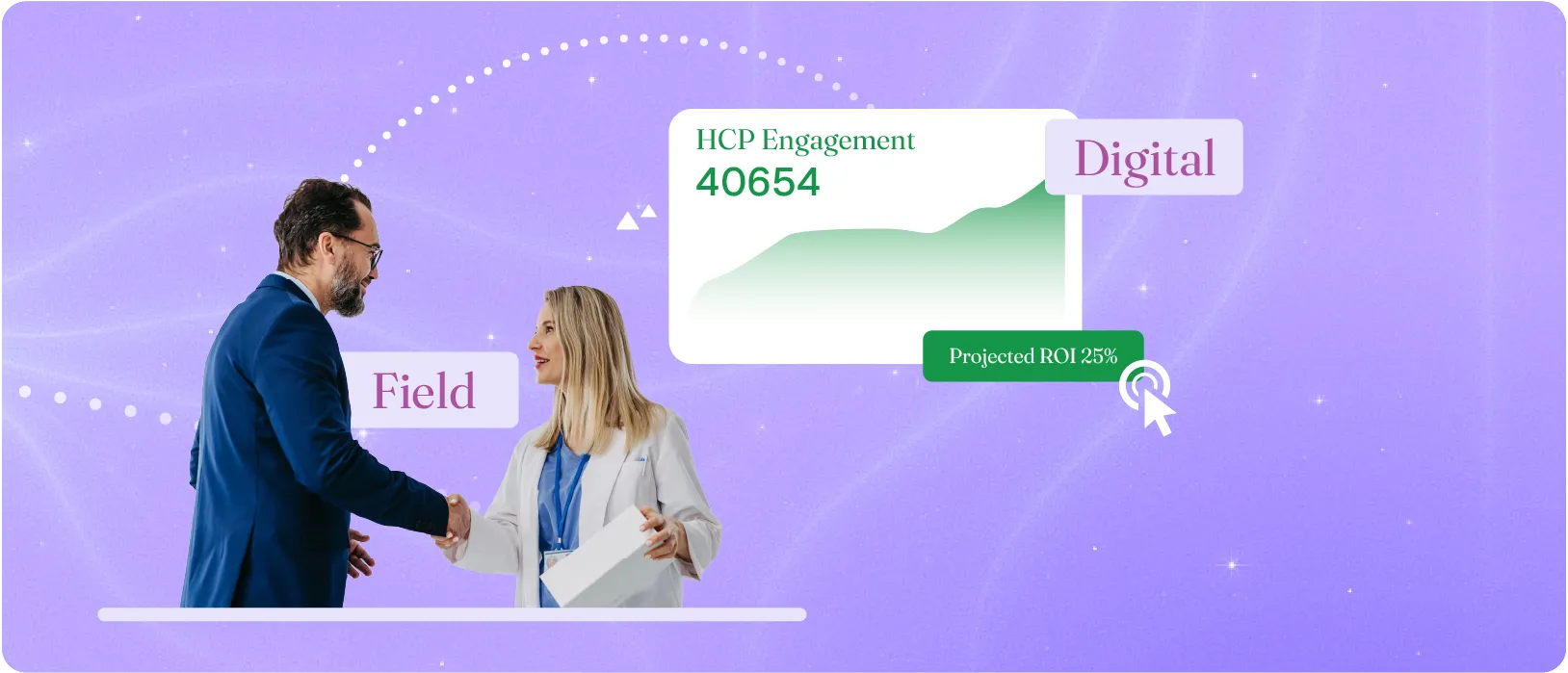
Effective HCP targeting shifts the focus from simple list matching (asking if an HCP belongs in a segment) to decision matching (determining the optimal next interaction right now). The second question creates better alignment between data and execution. It also makes performance conversations more useful because marketers can examine the signal, action, response, and outcome as a connected chain. Rather than managing channels in isolation, optichannel orchestration evaluates audience context, prior response history, field capacity, and commercial priorities to dispatch the optimal next touchpoint.
Signal-driven targeting works best when teams document four controls:
- Eligibility: who can receive the communication or field action.
- Relevance: which signal makes the interaction useful now.
- Frequency: how often a person can be reached across channels.
- Measurement: which outcome determines whether the tactic continues.
Those controls keep precision from becoming over-activation. They also provide a clear brief for brand, data, media, field, and medical teams.
How should brands segment HCP and DTC audiences?
HCP and DTC segmentation should reflect the audience’s role, need, stage, and response pattern. HCP segments can emphasize clinical relevance, access, and prescribing context. DTC segments can emphasize diagnosis, treatment journey, content need, and intent. Both require clear eligibility, approved messaging, and outcome-based measurement.
HCP and DTC audiences need different strategies because they make different decisions. An HCP may need concise clinical information, peer evidence, or a field conversation. A patient or caregiver may need help understanding a condition, finding a specialist, or navigating a support resource. We’ll dive into DTC engagement in a separate post due to very different constraints related to targeting, privacy, and campaign architecture.
For HCP marketing, useful dimensions include patient population, treatment behavior, account context, access, recent activity, formulary restriction mapping, and preferred channel. Specialty is not enough, as a segment should clearly lead to a different action. If every segment receives the same message and cadence, the segmentation is cosmetic. Explore HCP marketing solutions for signal-driven audience activation.
Segmentation should also account for lifecycle stage. A pre-launch audience may need education and awareness. A launch audience may need high-intent support and coordinated HCP activity. A mature brand may need adherence, switching, or competitive differentiation programs. The strategy changes with the commercial question, even when the core platform remains the same.
A segmentation test for brand teams
Ask whether each proposed segment changes at least one of these choices: the message, the channel, the cadence, the field action, the suppression rule, or the success metric. If it changes none of them, combine the segment with a broader group and direct the effort toward a decision that can improve performance.
Segmentation is also where marketing and medical affairs must stay connected. An audience definition can influence the content that is surfaced, the rationale given to a field representative, and the claims review required before activation. Build those checks into the workflow before launch rather than treating compliance as a final handoff.
Why does optichannel orchestration outperform channel-by-channel planning?
Optichannel orchestration selects the next best channel for each audience and moment while coordinating digital, field, and medical activity around the same journey. It can reduce conflicting messages, improve timing, and help teams learn which combination of actions contributes to the desired commercial outcome.
Multichannel plans often divide work by channel. The email team optimizes email. The media agency optimizes impressions. The field team manages calls. Each group may perform well inside its own report while the customer experiences repetition, delay, or mixed priorities.
Optichannel planning starts with the customer’s context. The system evaluates available signals, prior engagement, channel preference, field capacity, message eligibility, and the current commercial objective. It then recommends the next action most likely to be useful. The answer may be a digital touch, a field prompt, a content update, a pause, or a coordinated sequence.
PharmaForceIQ’s platform combines a Digital Orchestration Engine with a Field Orchestration Engine powered by Next-Best-Action technology. The field layer can deliver context-rich recommendations inside existing CRM workflows, including Veeva. A transparent rationale matters because reps adopt recommendations faster when they understand the reason behind them. See how coordinated execution connects field and digital activity.
The orchestration model should protect the customer from internal complexity. A healthcare professional should receive a coherent experience even when several teams contribute to it. A patient should encounter a clear path to relevant information rather than a series of disconnected ads. After all, the audience doesn’t know which team is behind which message. Coordination is a performance lever and a trust requirement.

Build an orchestration scorecard
| Decision | Question to answer | Useful measure |
|---|---|---|
| Audience | Who has a relevant signal now? | Eligible and prioritized profiles |
| Message | What approved information fits the need? | Content utilization and response |
| Channel | Where is the next action most useful? | Qualified engagement by channel |
| Sequence | What should happen after the response? | Journey progression and handoff rate |
| Outcome | Did the action improve the commercial goal? | NPI-level lift or agreed outcome |
Use the scorecard to expose gaps. If teams can report delivery but cannot explain the next action, orchestration is incomplete. If a recommendation cannot show its rationale, adoption will suffer. If a sequence has no stopping rule, frequency and compliance risks grow.
How do you measure pharmaceutical marketing strategies at the NPI level?
NPI-level measurement connects a specific HCP’s eligible exposure and engagement with a defined commercial outcome, such as prescription lift. It gives brand teams a more useful view than aggregate clicks or impressions when identity resolution, privacy controls, attribution rules, and comparison methods are documented.
Measurement is where many pharmaceutical marketing strategies lose credibility. Teams may have dashboards full of impressions, clicks, video completions, and visits while leadership still asks which activity influenced prescribing. Those metrics have a role, but they describe delivery and engagement. They do not answer the commercial question by themselves.
NPI-level attribution creates a tighter chain. It links an identified HCP to eligible exposure, engagement, field activity, and a defined prescription measure. PharmaForceIQ delivers dashboards designed to show engagement and Rx lift in real time, along with NPI-level attribution that connects touchpoints to script lift. The method still needs careful design, latency adjustment, and clear technical mechanics. Attribution is only as strong as the match, window, baseline, and controls behind it. Review data and technology capabilities for measurable life sciences engagement.
Document the attribution contract
- Identity: Define how an NPI is matched across approved data sources and where confidence thresholds apply.
- Exposure: Record the touchpoint, message, channel, date, and eligibility state.
- Window: State how long after exposure a response can be associated with the tactic.
- Baseline: Use a defensible comparison group or pre-period so lift is not confused with normal variation.
- Outcome: Agree on the prescription, engagement, or business measure before the campaign runs.
- Review: Document privacy, data governance, and medical or legal review requirements.
The same framework can support optimization before a final prescription readout. A team can compare qualified engagement, content completion, field action adoption, or progression to the next journey stage. Early indicators help operators change course faster. Final outcome metrics help leadership decide where to scale investment.
Attribution should create accountability without pretending to eliminate uncertainty. Report what the data supports, label modeled results clearly, and show the decisions that followed from the measurement. That standard earns more trust than a single inflated return figure.
What compliance guardrails should govern pharmaceutical marketing?
Compliance guardrails should define audience eligibility, approved claims, review ownership, frequency, data use, suppression, and audit evidence before activation. Marketing, medical, legal, privacy, and commercial teams need a shared operating record so speed does not bypass review or make an action impossible to explain later.
Speed matters in a signal-driven model, but speed without controls creates avoidable exposure. Every signal should have a documented source, permitted use, and business rule. Every message should have an approval status, version, and expiration path. Every channel should have frequency, consent, and suppression controls that are easy to inspect.
Medical affairs belongs in the operating model early. The team can help define the information need, identify where a field recommendation requires context, and establish how inquiries or unsolicited requests should be handled. The goal is a clean handoff between useful engagement and medical response, with roles clear before launch. See how medical affairs teams can coordinate relevant engagement and insight.
Build a preflight checklist that answers six questions:
- Is the audience eligible under the applicable data and privacy rules?
- Is the trigger meaningful, current, and permitted for this use?
- Is the content approved for the intended audience and channel?
- Are cadence, suppression, and opt-out rules active?
- Can the team explain why this action was selected?
- Will the measurement method respect governance and reporting requirements?
These controls should live in the workflow, not in a static document that operators consult only during an audit. A platform that can surface approved content, explain a next-best action, and preserve measurement context makes responsible execution easier to repeat.
How should teams choose a pharmaceutical marketing strategy?
Choose a pharmaceutical marketing strategy by matching the business problem to the signal, audience, action, control, and outcome. Start with one measurable use case, establish data and review requirements, connect the responsible teams, and scale only after the operating loop produces evidence.
A useful starting point is a narrow commercial question. Can the team respond faster to a diagnosis signal? Can it improve field adoption of a next-best action? Can it reduce waste in a specialty audience? Can it connect an HCP touchpoint to prescription lift? A focused question produces a stronger test than a broad transformation program with no clear decision owner.
From there, map the operating requirements. Identify the signals available today, the audience that can be reached, approved content, the field and digital actions, the required integrations, and the outcome that leadership will review. Include the people who own data, brand, medical, legal, sales, and analytics decisions.
PharmaForceIQ built its platform for pharmaceutical and biotechnology companies across pre-launch, launch, growth, and maturity stages. The right use case will differ by portfolio, therapeutic area, field model, and data readiness. A launch team may prioritize speed and coordinated education. A mature brand may prioritize efficiency, adherence, or competitive response. Explore the PharmaForceIQ platform and its connected engagement model.
Choose the strategy that makes the next decision clearer. If the team cannot explain who should be contacted, why now, which content is appropriate, and how success will be measured, the plan needs more work before budget increases. Clear decisions are the foundation of measurable growth.
Frequently Asked Questions About Pharmaceutical Marketing Strategies
What are the most effective pharmaceutical marketing strategies?
The most effective strategies connect signal-driven audience selection, HCP and DTC segmentation, coordinated digital and field execution, compliant content, and NPI-level measurement. The right mix depends on the brand’s lifecycle stage, therapeutic area, data readiness, and commercial outcome.
What is optichannel marketing in pharma?
Optichannel marketing selects and coordinates the next best channel for a specific customer and moment. It can combine digital, field, and medical activity around one journey instead of asking each channel team to optimize in isolation.
Why does NPI-level attribution matter?
NPI-level attribution helps a brand connect eligible HCP exposure and engagement with a defined prescription or commercial outcome. It provides a more actionable view than aggregate impressions while still requiring documented identity resolution, baselines, measurement windows, and governance.
How can pharmaceutical brands use real-time signals responsibly?
Brands can use real-time signals responsibly by documenting the source, permitted use, eligibility rules, approval status, frequency limits, suppression logic, and measurement method before activation. Medical, legal, privacy, and commercial owners should have clear roles in the review process.