

Multichannel marketing in pharma can be easy to launch and hard to justify once the numbers arrive. A brand may add email, paid media, portals, and field coverage, then find that one HCP heard the same message twice while another received nothing useful. The important choice is where the next dollar and hour of field time will do the most good.
Discuss your engagement priorities
Start multichannel marketing in pharma with a decision
Launch month puts pressure on the brand team. Leadership wants awareness, a credible conversation with the right physicians, and an early read on performance. Those physicians are managing full clinic days while messages arrive from many different directions. A message that misses the practice, patient mix, or moment becomes noise, even when reach looks healthy.
Channel mix should follow the brand’s commercial job, not rigidly adhere to a pre-planned 12-month media calendar. At launch, that may mean awareness, treatment-adoption barriers, and appropriate education. During growth, it may mean finding HCPs with unmet information needs and concentrating effort there. In-line brands may need to address a specific barrier or reduce spending where another contact is unlikely to help. The stage should shape the plan before channels are assigned, leaving flexibility to adapt quickly as the landscape changes.
Start with a concrete choice. An eligible HCP opens an approved disease-state resource. Should the next step be a rep visit, a digital follow-up, or no additional contact? That question identifies the audience, cue, and available actions. “Activate email, media, and reps” does not adequately cover the context for most impactful touchpoint.
Choose one primary outcome and the early checks that keep it honest. Better access to approved information, more relevant field time, fewer conflicting touches, and a commercial result are different outcomes. Pair the chosen result with operational reads that show whether the program is functioning while the slower measure develops. An AI model can help make these decisions happen quickly at scale.
Three models often appear in conversations. Multichannel runs several channels, often side by side. Omnichannel connects the experience so activity in one place can inform another. Optichannel uses available context to choose a channel, message, and moment that makes sense for an individual HCP.
A focused multichannel plan can fit defined reach or education for some limited situations. Connected decisioning is key when a field action should change what digital does next, and the reverse. Optichannel is the best evolution that can still drive impact across as few as 2-3 channels, but with connection to impact how those channels work together. Read how optichannel differs from broad channel distribution and how coordinated omnichannel engagement can fit existing operations.
Map who the interaction is for, and what job it does
A target list shows who might matter, and segmentation can help prioritize and rank investment. Which HCPs have the greatest unmet information needs? Where are the barriers to appropriate adoption? Which segments justify field time, which are better served digitally, and where would more spending change nothing?
Build those answers from details that can change the next action: specialty, practice context, relationship, stated information need, permitted channel preference, and applicable inclusion or exclusion rules. An HCP with a clear information gap and room on the rep’s calendar is a different investment from one who already has the message and prefers to read.
Give each touchpoint a clear goal that a brand lead and field manager would recognize. A resource can introduce a disease-state topic, a rep conversation can answer an information need, and a digital reminder can continue an approved sequence. When two channels share a job, explain why the repetition helps.
Keep the map visible to marketing, field operations, analytics, IT, and reviewers. The useful questions are simple: why does this HCP qualify for this level of investment, and why does this action follow from the evidence available now? Optichannel models will make the most of every touchpoint, helping answer these questions without blowing out your budget.
| Decision area | Specify before activation | Practical review question |
|---|---|---|
| Audience | Segment, inclusion rules, exclusions, and permitted use | Which HCPs justify this investment? |
| Need or cue | Unmet need, barrier, preference, or relationship context | Is it current, interpretable, and permitted? |
| Action | Approved content, channel, and intended next step | Does field or digital fit this segment? |
| Capacity and timing | Rep availability, contact limits, and sequence | Can it happen while it is useful? |
| Evidence | Operational measures, outcome, and comparison | Where should the next dollar go? |
Let HCP context change the next action
Consider two oncologists who open the same approved education piece on a Tuesday. One has a call on the calendar and prefers a conversation, so the engagement can directly inform that visit. The other saw the rep last week, prefers to read emails, or has no current reason for another conversation. A later digital resource, scheduled review, or no further outreach may be better.
The cue is the same, but the investment case differs. Turning every open into a rep task consumes field time the brand may need elsewhere. Obscuring every digital response from the field, though usually unintentional due to black box media buying, can waste a timely visit. Let HCP context, preference, capacity, and need for contact change the action, and know that sometimes no additional contact is a legitimate decision.
Put the recommendation in the CRM the team already uses, Veeva or Salesforce. Give the rep one sentence naming the cue and proposed action, like “Dr. Smith opened the approved efficacy resource and a follow-up resource may fit the scheduled call on Tuesday.” See next best action across field and digital channels and strategy orchestration for commercial teams.
Give each channel a role, a budget, and an owner
Once context shapes the next action, the remaining question is how the organization will run it. Digital media can provide approved information at scale. A field visit can carry a conversation when need and capacity support it. Email can deliver a defined follow-up when consent and policy allow it. Choose the mix from the audience, content, timing, permissions, and work the team can sustain.
Give every channel a role and a budget owner. If a placement introduces a resource, describe what follows: a useful detail, another resource, or time to read. If the field handles a question, specify the context the rep receives. A click records an interaction, but it does not establish a clinical need or prescribing change.
Read an example sequence as the HCP would. Can brand and field send the same event invitation because their calendars do not connect? Does a campaign continue after an opt-out or after the content no longer fits? Set contact limits and name who resolves a collision.
Decide what evidence would move money between channels. A recent cue supports follow-up only when identity, freshness, permission, and context support that reading. When a channel looks weak, check delivery, coverage, content fit, and the measure before moving budget.
Do not promise speed the data cannot support
“We have the data” says little about what the team can do this week. Most pharma brand teams have more than enough data and lots of dashboards, with little ability to act on them quickly or effectively.
A cue is useful when the program can ingest it, read it for that individual HCP, and start an approved journey or record a hold while the moment matters within 48 hours. It depends on recency/freshness, identity, permission, approved content, review rules, and an open channel:
- Freshness: Set the age at which each action is off the table. A recent cue may support a timely review. An older one may still inform planning without triggering immediate contact.
- Identity: Separate a known, consented NPI interaction from an inferred or aggregate digital audience match.
- Permission: Record consent, privacy, and data-use limits before activation. A field sitting in the data warehouse is not automatically approved for every use.
- Actionability: Route the cue to an owner inside the workflow the team already uses. A feed that requires another browser window or app won’t get universal adoption.
- Fallback and coverage: State what happens when data is missing, late, or uncertain, and identify priority HCPs who sit outside the cue’s coverage.
Measure coordination, not just activity
Measurement should tell a brand leader where the next dollar goes, not only whether a campaign ran. Early reads cover recency, action accuracy, latency, delivery, holds, and recommendation acceptance. Engagement shows an interaction was received or acted on, while behavior change, commercial outcome, and incremental value need separate evidence.
| What the data shows | Strategic decision |
|---|---|
| High engagement, limited follow-up | Reassess the content or the next action |
| Strong field response, duplicated digital activity | Reallocate channel investment |
| Low engagement in a priority segment | Reconsider the message, channel, or audience |
| Commercial movement without a comparison | Do not claim incremental impact |
Prescription reporting can lag activity by 30 to 90 days, sometimes longer. A delivery report and commercial result therefore run on different clocks.
CRM attribution can connect known, consented interactions to later actions within its coverage without proving causation. Media-mix modeling works at territory or regional level. A matched-market or controlled test offers a stronger incrementality read when the design supports it.
Run a pilot that ends in a yes, a revise, or a stop
A useful pilot starts with one bounded commercial question: does a defined digital cue paired with eligible field follow-up improve a chosen measure compared with current practice? Pick an audience and geography the team can cover. Confirm the data, approved content, and field capacity, and state what the pilot will leave out.
- Scope: Name the use case, audience, channels, window, and exclusions.
- Comparison: Record the baseline and the differences that could cloud the result.
- Owners: Assign content, data, field enablement, analytics, and review.
- Threshold: Write the evidence required to expand, revise, or pause.
Pause when the evidence says the investment is no longer sound. Examples include integration delays that prevent timely follow-up, eligibility errors above tolerance, unresolved identity or consent issues, poor field usability, or insufficient data for a reliable outcome read.
Read reliability first, then engagement and commercial evidence on their actual timelines. Ask reps why they accepted or rejected a prompt. Timing, relevance, and workflow fit often appear there before they appear on a dashboard. At the close, expand within defined bounds, change one element and retest, or stop. Activity alone does not answer where the next dollar should go.
Questions worth asking a platform or a partner
Connecting systems does not automatically coordinate decisions. Brand, procurement, finance, analytics, and marketing should test the approach against the existing stack, owners, and approval path. Ask for a walkthrough from cue to action rather than a tour of channel features.
- Which inputs are available, how recent are they, and how can the team see identity confidence?
- Where does a recommendation appear for a rep, in Veeva or in Salesforce, and can that person read the reason in one sentence?
- How are eligibility, contact limits, holds, and the decision to do nothing configured and audited?
- What happens when a feed is late, a record will not match, or the rep cannot act?
- Which work is included in implementation and ongoing support, and which changes require a separate request or a change order?
- How will reporting keep delivery, engagement, commercial outcomes, and incrementality in separate columns, and show where the next dollar should go?
- What will the customer team still need to provide, approve, and maintain after launch?
Run the walkthrough on real constraints. Use a defined HCP segment, one approved content example, an unavailable cue, and a rep with no capacity. A credible design shows all four outcomes, including the decision to wait. Test integration options for pharma platforms and the PharmaForceIQ platform overview against those questions.
Frequently asked questions
What does multichannel marketing in pharma mean?
Multichannel marketing in pharma means using more than one channel to reach HCP audiences with approved information or experiences. The term describes breadth. It does not establish coordination or show that the mix fits the brand’s commercial stage.
How is multichannel different from omnichannel?
Multichannel can run several channels in parallel. Omnichannel connects the experience so activity in one place can inform another. The practical test is whether a cue changes what happens next within review rules and a timeline the team can meet. Optichannel is a valuable middle ground without the expense and implementation timelines – connecting as few as 2-3 channels to drive impact and coordinate across channels to maximize investments.
When should a pharma team move beyond a channel campaign?
Consider connected decisioning when field capacity, digital activity, and HCP context should change one another, or when duplicate outreach and split reporting make spending hard to defend. Start with one bounded use case and confirm the data, review path, workflow, and measure before widening it.
What should a pharma team measure in a multichannel pilot?
Start with freshness, eligible actions, delivery, and holds. Then read engagement. Judge a commercial outcome only against a comparison and a pre-set window. Use the result to decide where the next dollar goes, keeping activity, engagement, behavior change, commercial results, and incrementality separate.
The strongest plan is rarely the one with the most touches. It gives each permitted interaction a clear job, fits the HCP’s context and the brand’s stage, and leaves evidence for the next investment decision.
Approach
By pre-synthesizing data, tracking interactions and delivering strategically timed, compliant emails within the CRM, the solution removed the most burdensome MCM tasks from the rep’s plate. Guided by high-value suggestions and insights, reps felt more empowered to send approved emails, increasing between-visit touches without creating a disjointed user experience for the HCP.
Impact
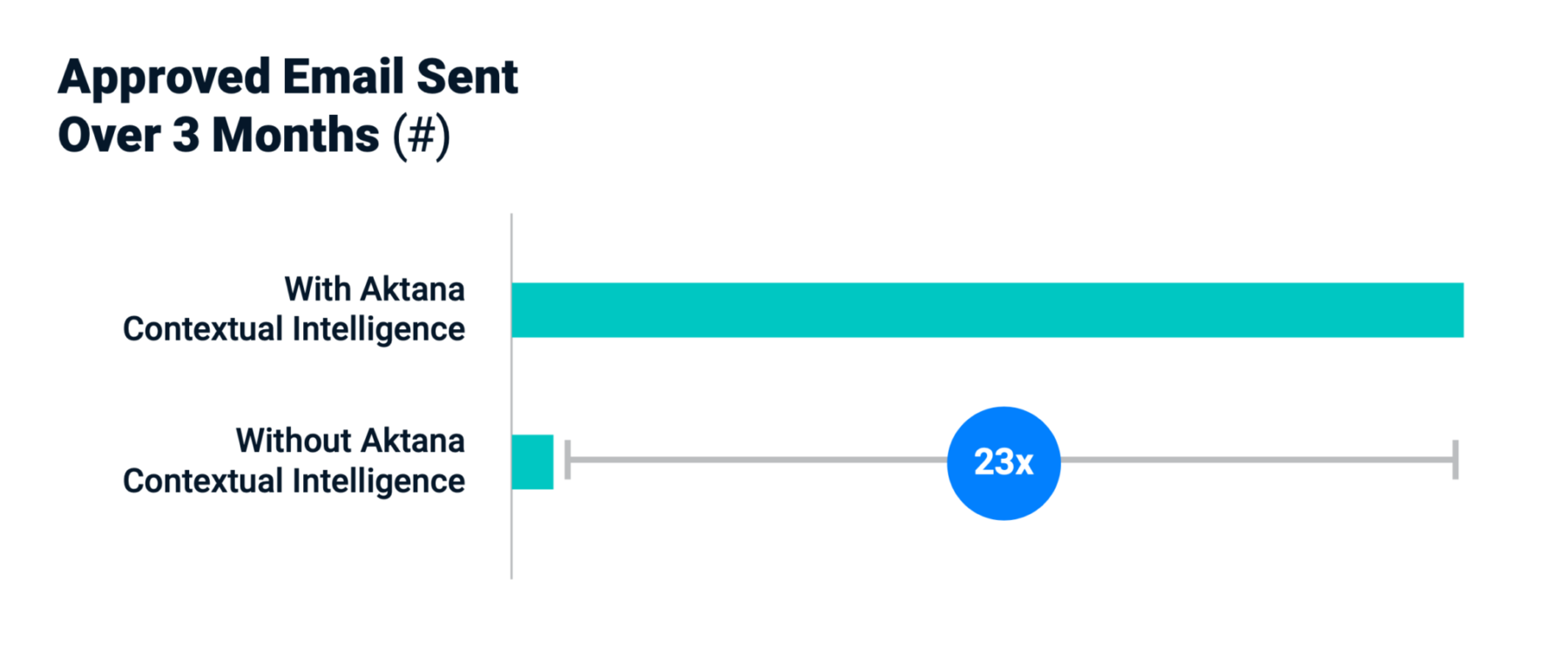
23x more emails sent in three months
Aktana’s suggestions led to a dramatic increase in rep use of Veeva CRM Approved Email.
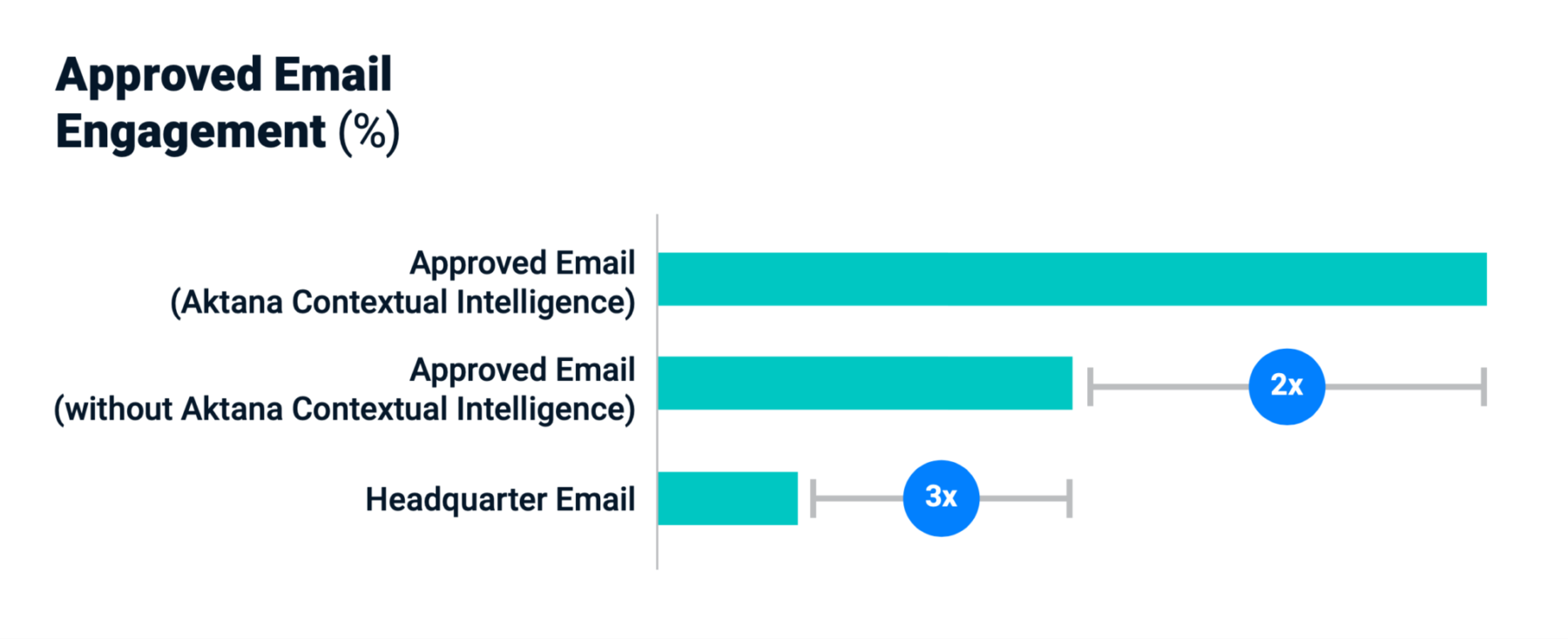
Two-fold increase in engagement
When reps sent approved emails and letters prompted by suggestions, HCPs were twice as likely to open them.
Significant platform-attributed impact
Compared to a control group, HCPs who received suggestion-driven letters and emails from reps were responsible for a 4% increase in new prescriptions. Suggestions were generated using data inputs including brand strategy, HCP segmentation, Rx data and activity from both reps and HQ.