
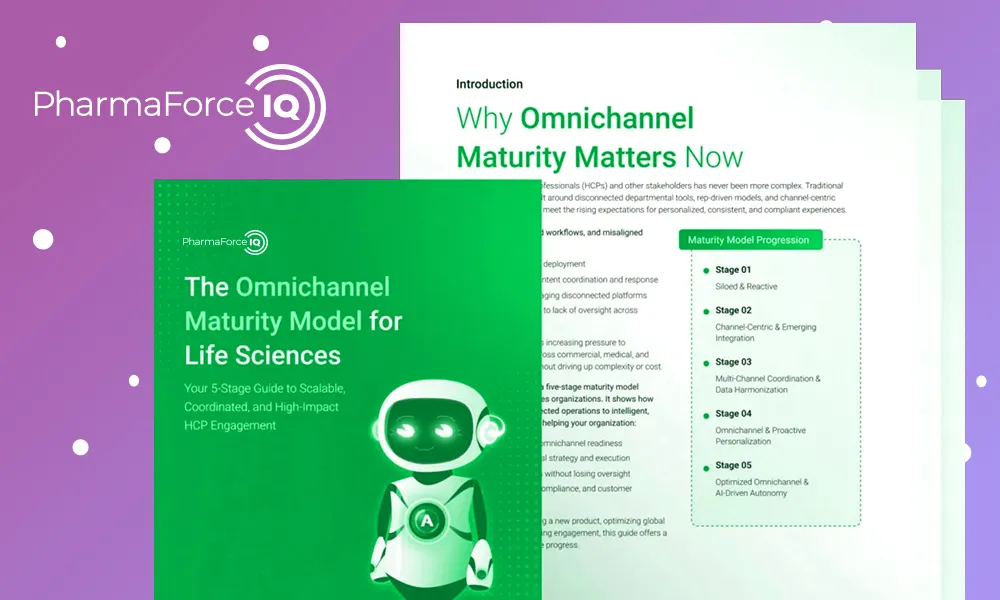
What is an omnichannel maturity model for life sciences?
An omnichannel maturity model for life sciences is a framework that shows how a pharma organization progresses from siloed, reactive engagement to coordinated, personalized, and AI-supported orchestration. It helps teams benchmark pharma omnichannel capabilities, expose operational blockers, and prioritize measurable improvements across field, marketing, brand, and medical affairs.
An effective omnichannel strategy in pharma is about more than adding channels. The optichannel vs omnichannel distinction clarifies how teams prioritize those decisions. Teams also need to ensure that execution, data, and decision-making move in sync across field, marketing, brand, and medical teams.
Ready to benchmark your engagement model? Request a demo.
What are the five stages of pharma omnichannel maturity?
The model moves from disconnected execution to intelligent, self-optimizing orchestration. Each stage describes a practical capability shift, so teams can identify the next improvement without losing sight of governance or measurable outcomes.
| Stage | What it looks like | Priority for progress |
|---|---|---|
| Stage 1: Siloed and Reactive | Teams work from disconnected tools, data, and channel plans. | Create shared ownership and remove basic handoff gaps. |
| Stage 2: Channel-Centric and Emerging Integration | Individual channels begin connecting, but coordination remains limited. | Define common data, workflows, and measurement rules. |
| Stage 3: Multi-Channel Coordination and Data Harmonization | Field, marketing, brand, and medical teams align activity around shared signals. | Standardize data and use consistent customer identifiers. |
| Stage 4: Omnichannel and Proactive Personalization | Engagement sequences adapt to HCP context across field and digital channels. | Operationalize timely, compliant personalization. |
| Stage 5: Optimized Omnichannel and AI-Driven Autonomy | Closed-loop orchestration continuously improves decisions with human oversight. | Scale AI with transparency, governance, and review. |
How can life sciences teams use an omnichannel maturity model?
Life sciences teams can use the model as a shared planning tool across commercial and medical functions. The goal is practical progress, not a label. Start with the current operating reality, then select the capability improvement that will remove the largest constraint.
- Benchmark current capability: Compare data, workflows, channel coordination, personalization, and measurement with the five stages.
- Align cross-functional teams: Use the same maturity language across field, marketing, brand, and medical stakeholders.
- Prioritize the next blocker: Focus investment on the gap limiting scale, speed, personalization, or measurable impact.
- Introduce AI responsibly: Add AI with transparency, governance, and oversight when the underlying data and workflows are ready.
- Measure progress: Track operational improvements and engagement outcomes as the organization moves to the next stage.
What is inside the report?
- A breakdown of the five stages of pharma omnichannel maturity, from disconnected execution to AI-supported orchestration
- Common blockers and operational gaps at each stage
- Milestones to align field, marketing, brand, and medical teams
- Examples of how life sciences organizations are making progress
- Guidance on when and how to introduce AI without losing control
- Practical next steps for teams navigating CRM transitions or global scale
Download the Pharma Omnichannel Maturity Model
Download the PDFWhat is an omnichannel maturity model for life sciences?
An omnichannel maturity model for life sciences is a framework that shows how a pharma organization progresses from siloed, reactive engagement to coordinated, personalized, and AI-supported orchestration. It helps teams benchmark capabilities, expose operational blockers, and prioritize measurable improvements across field, marketing, brand, and medical affairs.
Omnichannel strategy is about more than adding channels. Teams also need to ensure that execution, data, and decision-making move in sync across field, marketing, brand, and medical teams.
Ready to benchmark your engagement model? Request a demo.
What are the five stages of pharma omnichannel maturity?
The model moves from disconnected execution to intelligent, self-optimizing orchestration. Each stage describes a practical capability shift, so teams can identify the next improvement without losing sight of governance or measurable outcomes.
| Stage | What it looks like | Priority for progress |
|---|---|---|
| Stage 1: Siloed and Reactive | Teams work from disconnected tools, data, and channel plans. | Create shared ownership and remove basic handoff gaps. |
| Stage 2: Channel-Centric and Emerging Integration | Individual channels begin connecting, but coordination remains limited. | Define common data, workflows, and measurement rules. |
| Stage 3: Multi-Channel Coordination and Data Harmonization | Field, marketing, brand, and medical teams align activity around shared signals. | Standardize data and use consistent customer identifiers. |
| Stage 4: Omnichannel and Proactive Personalization | Engagement sequences adapt to HCP context across field and digital channels. | Operationalize timely, compliant personalization. |
| Stage 5: Optimized Omnichannel and AI-Driven Autonomy | Closed-loop orchestration continuously improves decisions with human oversight. | Scale AI with transparency, governance, and review. |
How can life sciences teams use an omnichannel maturity model?
Life sciences teams can use the model as a shared planning tool across commercial and medical functions. The goal is practical progress, not a label. Start with the current operating reality, then select the capability improvement that will remove the largest constraint.
- Benchmark current capability: Compare data, workflows, channel coordination, personalization, and measurement with the five stages.
- Align cross-functional teams: Use the same maturity language across field, marketing, brand, and medical stakeholders.
- Prioritize the next blocker: Focus investment on the gap limiting scale, speed, personalization, or measurable impact.
- Introduce AI responsibly: Add AI with transparency, governance, and oversight when the underlying data and workflows are ready.
- Measure progress: Track operational improvements and engagement outcomes as the organization moves to the next stage.
What is inside the report?
- A breakdown of the five stages of pharma omnichannel maturity, from disconnected execution to AI-supported orchestration
- Common blockers and operational gaps at each stage
- Milestones to align field, marketing, brand, and medical teams
- Examples of how life sciences organizations are making progress
- Guidance on when and how to introduce AI without losing control
- Practical next steps for teams navigating CRM transitions or global scale